SIL Crosses the Line With Parenting Shaming, Woman Exposes Cheating Scandal at Family Dinner
You’re definitely not the asshole here. Skipping a birthday party that wasn’t really for you—and avoiding an emotionally manipulative setup—isn’t selfish. It’s self-care.
You don’t owe anyone your presence when they’ve made your comfort and consent an afterthought. And if people are mad at you for missing a party they weren’t even throwing for you, that speaks volumes about them—and nothing about you.
You did the right thing. Protect your peace. And maybe next year… plan a birthday that’s truly yours.
We’ve all met that one person who constantly criticizes, nitpicks, or throws subtle insults just to get a reaction, but eventually even the most patient person reaches their limit

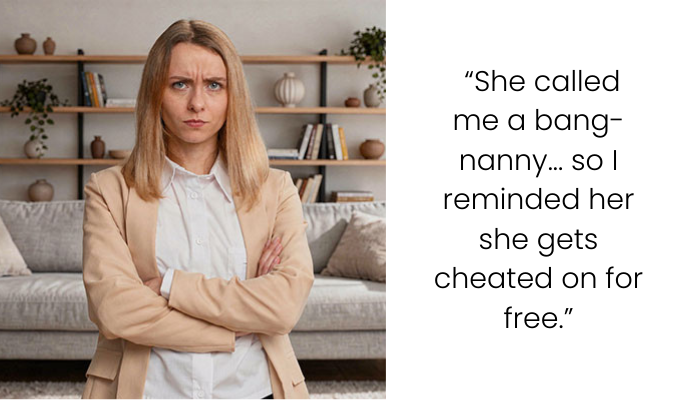
The author’s sister-in-law often criticized her husband and made snide comments about her, including calling her a “married single parent”
Let’s break this down, because there’s more going on here than just some holiday drama. What happened wasn’t just a petty squabble—it’s a clear example of toxic in-laws, emotional manipulation, and the fallout that occurs when boundaries are ignored for too long.

1. SIL Behavior: Microaggressions Turned Major Aggression
Alison’s behavior is all too familiar for many who’ve dealt with toxic in-laws. At first, her comments might seem like passive-aggressive digs—small jabs at parenting roles and household responsibilities. But when someone keeps making the same pointed remarks over and over, it’s no longer passive; it’s deliberate.
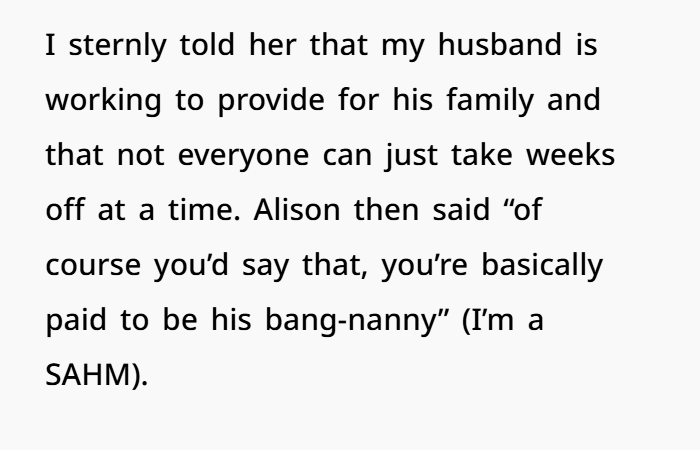
What Alison is doing here is weaponizing gender roles. By mocking the dad for “babysitting,” smirking at him for not knowing baby trivia, and calling the narrator a “bang-nanny,” she’s trying to undermine their relationship and the way they parent. This isn’t about concern or curiosity—it’s about contempt.
The “bang-nanny” comment, in particular, is deeply misogynistic. It implies:
- Stay-at-home moms don’t do real work.
- The only value a stay-at-home mom provides is sex.
- The husband is exploiting her.
That’s not just rude. It’s dehumanizing.
2. Why This Cut Deeper Than It Looks
It’s one thing to roll your eyes at bad behavior. But when that behavior is relentless and targeted, it becomes emotional abuse. What makes this even worse? OP tried to set boundaries—multiple times. She asked Alison to stop. She asked Harvey to step in. But no one did anything. That silence enabled Alison’s behavior to continue unchecked.
This is a common pattern in families: people tolerate the bully in the name of “keeping the peace,” but that peace comes at the expense of the victim’s comfort. When OP finally snapped, it wasn’t just an outburst; it was the breaking point of months (or years) of tension and built-up frustration.
3. Did She Go Too Far? Let’s Talk Ethics of Retaliation
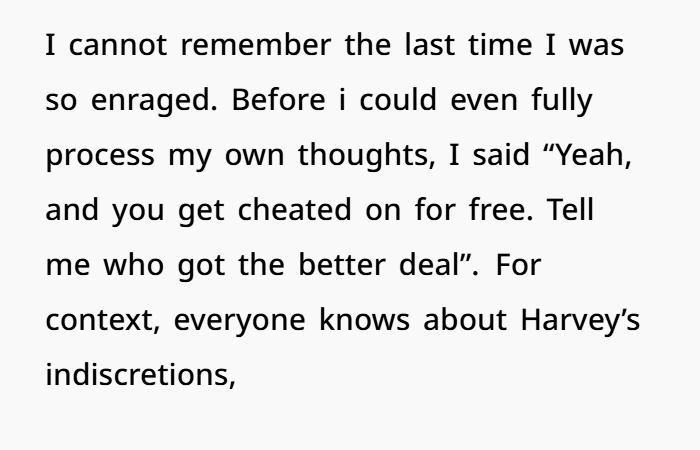
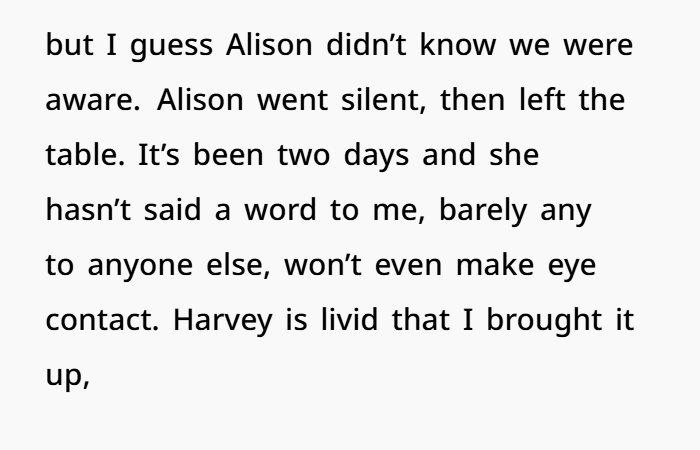
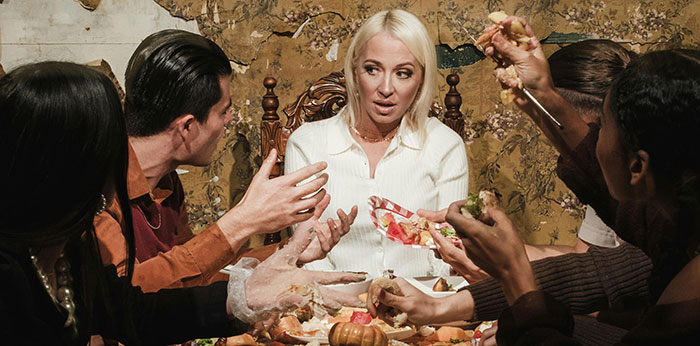
Now, here’s where things get complicated. OP’s response hit hard, but the truth was out in the open. Everyone knew about Harvey’s cheating, but it seems Alison didn’t realize that everyone knew. OP didn’t just make a comeback—she exposed Alison’s humiliation in front of the whole table.
Was it morally wrong to bring up the affair? Not necessarily. When someone repeatedly disrespects you publicly, they forfeit the right to maintain the moral high ground. OP didn’t out a private secret; she responded to a public insult with a public truth.
This is the “fuck around and find out” principle in action.
But emotionally? It was devastating. OP shattered Alison’s ego with one sentence. And that’s why this feels complicated—even if it was completely justified.
4. The Gender Role Backdrop
Let’s unpack the whole “babysitting” debate and why Alison might be so fixated on it. In modern families, the idea that dads are “babysitting” their own kids is seen as outdated. The argument is that you don’t babysit your own child—you parent them. And that’s a valid point.
But here’s the thing: both parents use the term playfully, yet only the husband is criticized for it. That’s not about the word itself—it’s about the undermining. Alison is using the “babysitting” jab as a way to attack him and his role as a father. And let’s not forget, this guy was working to provide for his family while Alison was tearing down his parenting. It’s clear the judgment wasn’t based on facts. It was based on spite.
What makes this worse? Calling a stay-at-home mom a “bang-nanny” implies that her domestic labor and parenting only matter if there’s sex attached. That’s not just offensive—it reflects how society often devalues domestic work done by women. It suggests that women’s work at home, particularly in the realm of child-rearing, is less valuable unless it serves a different purpose, like sex. It’s a disrespectful and misogynistic jab.
5. Harvey’s Role in All This
Let’s talk about Harvey for a second, because he’s notably absent when it comes to standing up for his family. His wife is harassing OP’s husband at every turn, and he does nothing to intervene. And when OP finally retaliates, Harvey gets mad? Sorry, but if Harvey wanted to keep his dirty laundry private, maybe he should’ve stepped in and stopped his wife from lighting a match in a room full of gasoline.
If you let your partner publicly antagonize family members and you do nothing, you’re not just passive—you’re complicit.
6. Public Shame vs Private Resolution
Was there another way to handle this? Maybe. OP could’ve pulled Alison aside privately and said, “If you ever call me that again, I’ll tell the whole table what I know about your marriage.” But the truth is, Alison would’ve never stopped unless there were consequences. She thought she was untouchable, and that smugness? Gone now.
Sometimes, public humiliation is the only language that bullies understand. When someone feels free to disrespect others without consequence, it often takes something as bold as a public comeback to get them to realize their behavior won’t be tolerated. OP did the right thing.

7. Should You Ever Air Someone’s Dirty Laundry?
In general, it’s good etiquette not to weaponize secrets, unless it’s in defense of yourself against real harm. OP didn’t randomly bring up Harvey’s cheating—it wasn’t an unprovoked attack. She wasn’t gloating or trying to “win” in some petty way. She was retaliating after being insulted repeatedly and publicly.
After being subjected to passive-aggressive digs, emotional undermining, and outright disrespect, OP’s response wasn’t just a comeback—it was a defense mechanism. When someone constantly crosses your boundaries, exposing the truth becomes a way to reclaim power. It wasn’t about starting drama; it was about stopping the cycle of disrespect in its tracks.
So was it kind? No.
Was it appropriate? Arguably, yes.
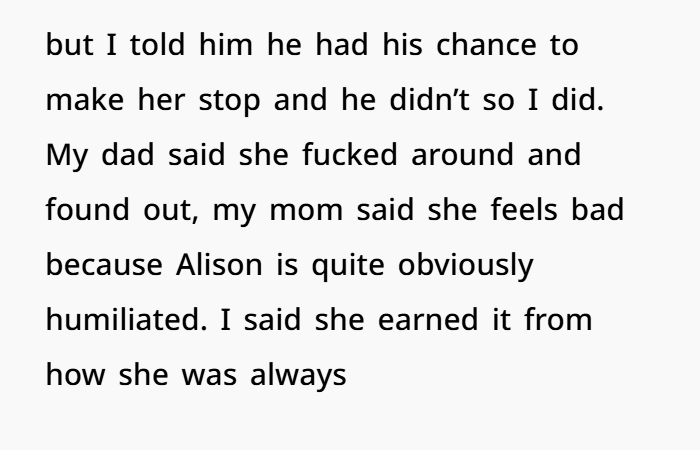
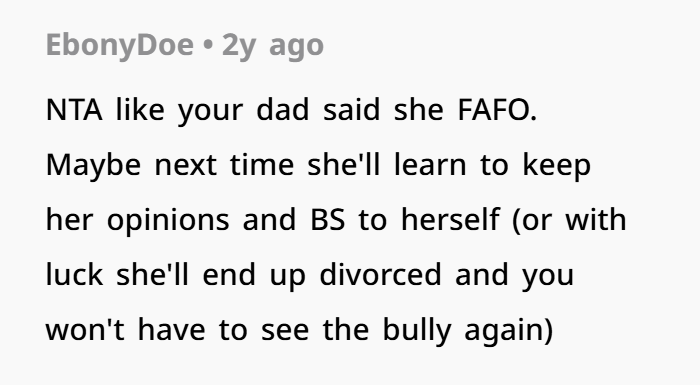
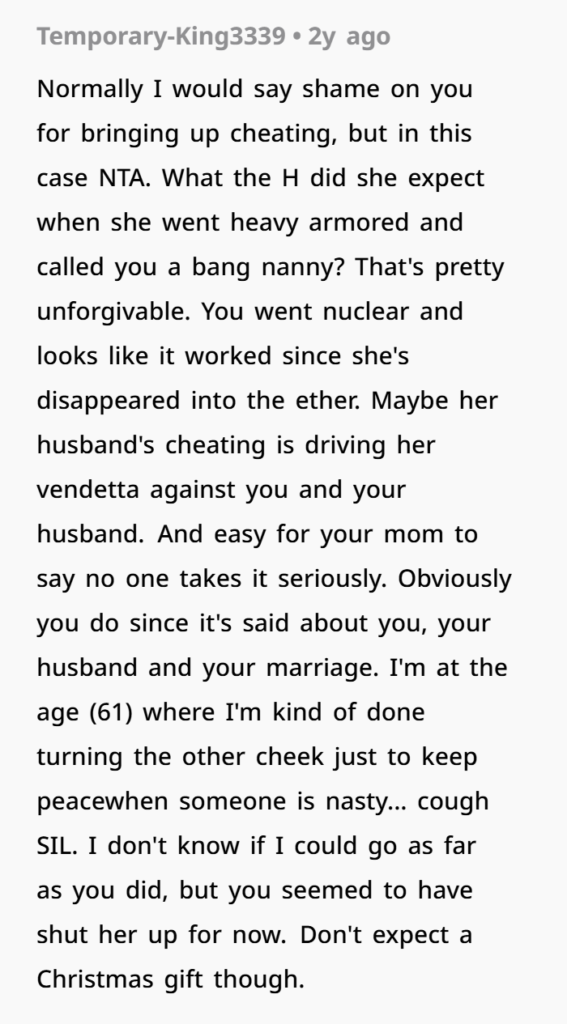
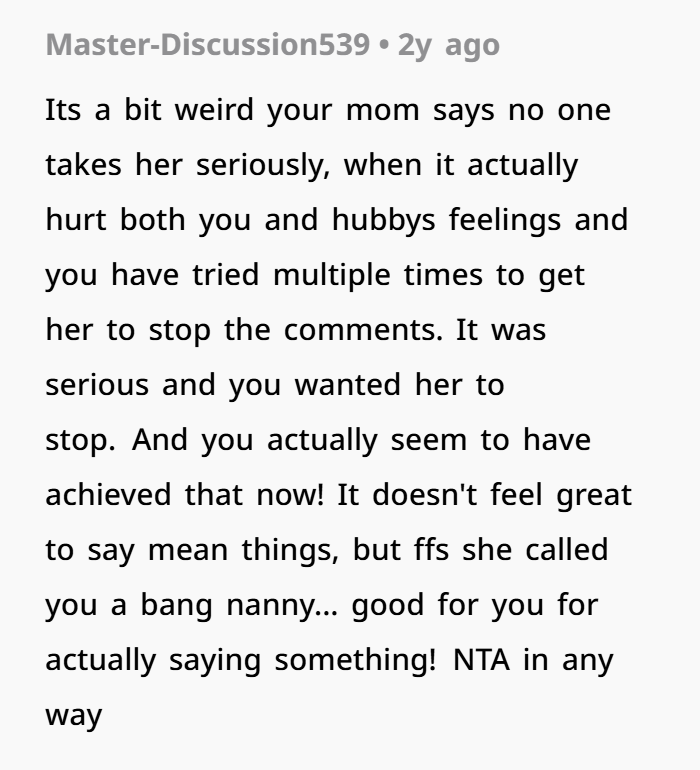
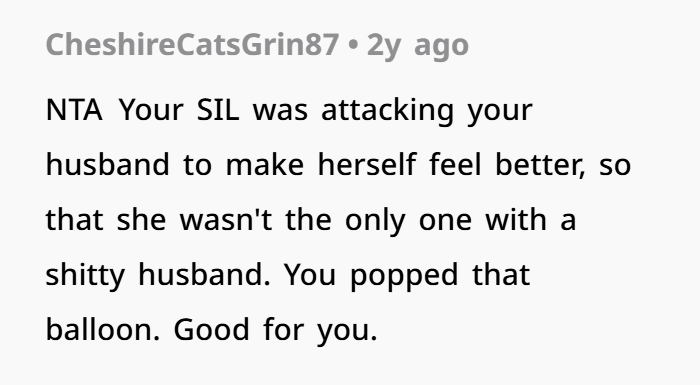
Netizens praised the author for standing up for her family and protecting her husband from ongoing harassment, and criticized the family for enabling the sister-in-law behavior
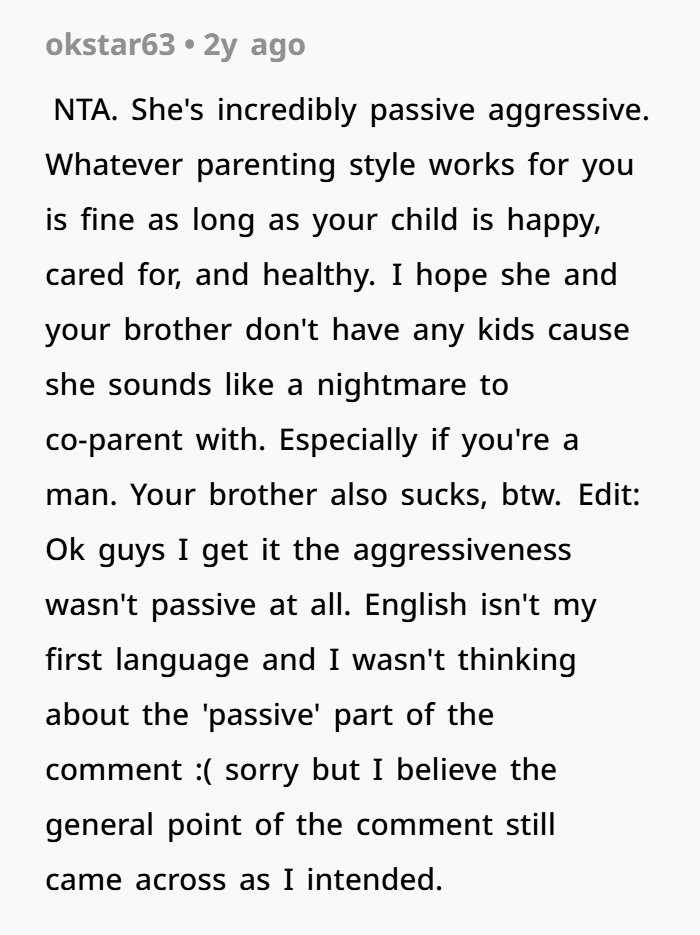
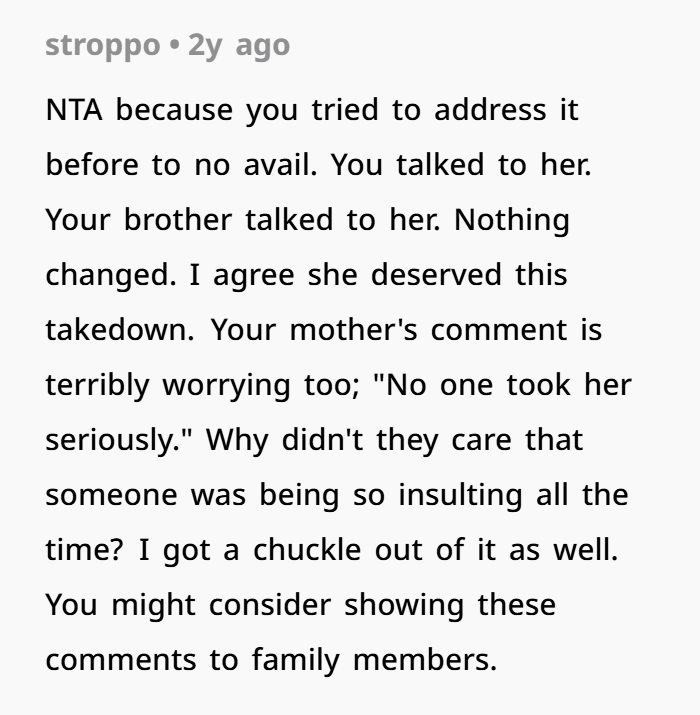
AITA for snapping at Alison? Absolutely not.
You tried diplomacy. You set boundaries. You even involved her husband. When none of that worked, you defended your family the only way left—by giving her a taste of her own medicine. Maybe it was brutal, but it was also earned.
Your SIL threw stones from a glass house. You just reminded her that it was already cracked. She couldn’t keep throwing jabs at others without facing the consequences of her own actions. You didn’t start the fight, but you definitely finished it.