I Refused to Share My Daughter’s 27 Gifts with Her Half-Brother—Now I’m the Villain?
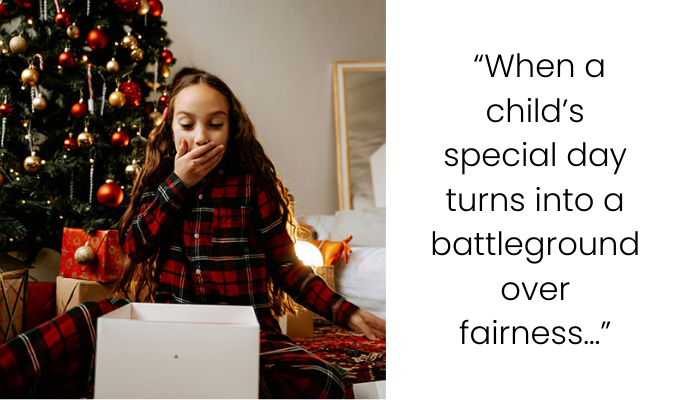
This situation involves a lot of complex emotions, but let’s break it down clearly:
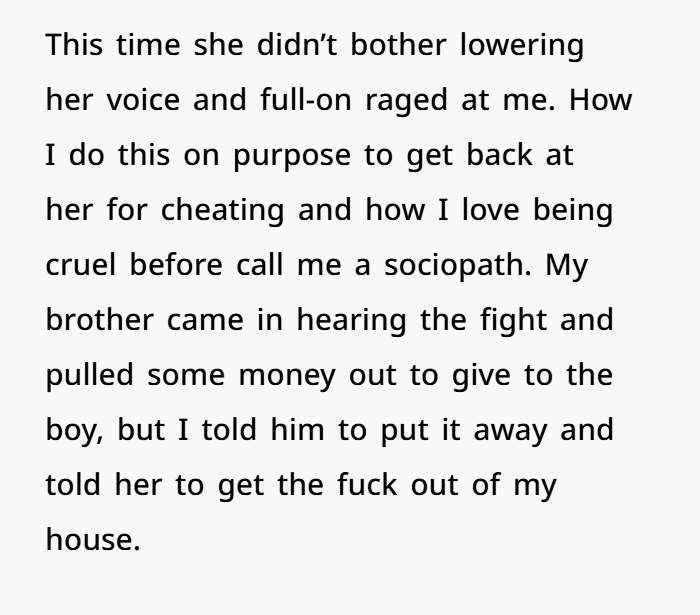
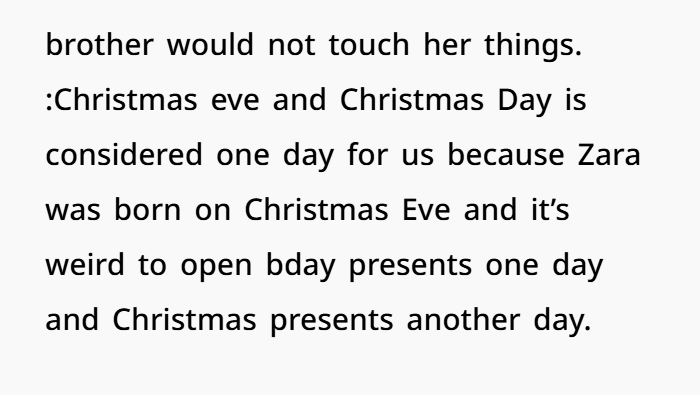
OP’s stance is entirely reasonable. He made a generous gesture for his daughter Zara, giving her 27 gifts for both her birthday and Christmas, as part of a family tradition. This wasn’t about being unfair to the other child—it was about honoring his daughter’s birthday and Christmas, something that OP has been doing consistently. Zara’s wish was clear: her half-brother could not touch her things, a boundary OP respected.
When the ex demanded that Zara’s gifts be shared with her son, despite Zara’s clear wishes, it crossed a line. It’s understandable that the ex might feel awkward or uncomfortable in a blended family situation, but her son’s lack of control over the family dynamics doesn’t mean Zara’s wishes should be disregarded. The gifts were tied to Zara’s birthday and good behavior, not a communal holiday giveaway, and OP wasn’t wrong to enforce her boundaries, especially when the ex didn’t respect Zara’s feelings.
It’s important to acknowledge that OP wasn’t being vindictive or cruel. He was standing by his daughter’s right to have her special day and respecting the boundaries she set. The ex’s request to “share” gifts didn’t consider Zara’s perspective or her history with her half-brother. Plus, it seems a little unfair to pressure OP to dilute his daughter’s special moment when the 5-year-old son only received a book.
Standing his ground was necessary, especially when things escalated. The fact that OP stopped his brother from giving money to the boy shows that he wasn’t trying to be punitive—he was simply enforcing his daughter’s wishes and preventing any further tension.
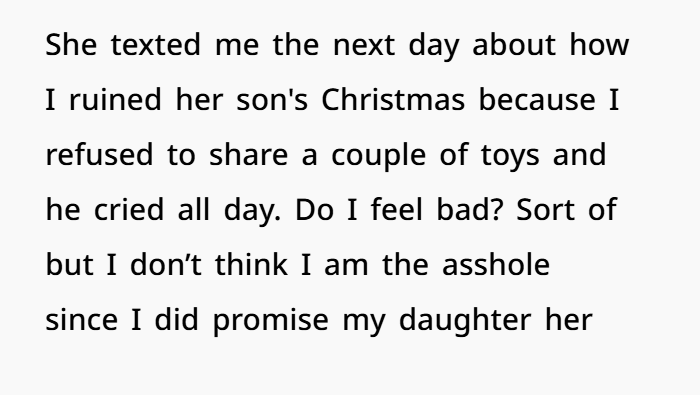
Now, the ex blaming OP for “ruining her son’s Christmas” is classic deflection. She’s trying to shift the blame from the situation she caused (by asking for Zara’s gifts) to OP’s refusal to bend. It’s clear she’s trying to manipulate the situation by leveraging her son’s disappointment, but OP’s priority should be respecting his daughter’s needs and ensuring she feels secure in her own home.
In the end, OP isn’t the asshole. He made a reasonable choice by standing firm on his daughter’s boundaries, and it’s not his fault the ex pushed for something unreasonable. OP’s role is to protect his daughter’s happiness and honor the traditions he’s set up for her—he did just that. If the ex is upset, that’s more of a reflection of her own discomfort with the situation, not OP’s actions.
A dad got his daughter 27 presents for Christmas and her birthday, but got none for her 5-year-old brother

His ex became furious and demanded that he ask her to share, but the dad refused

This situation may seem straightforward at first—“It’s her birthday and Christmas; she earned those gifts!”—but when we dig deeper, it reveals a much more complex emotional dynamic rooted in unequal family structures, unresolved tensions, and the challenges of co-parenting.
Let’s break this down through the lenses of emotional fairness, co-parenting ethics, child psychology, and of course, holiday expectations.
Birthday + Christmas = 27 Gifts? That’s Not the Real Problem
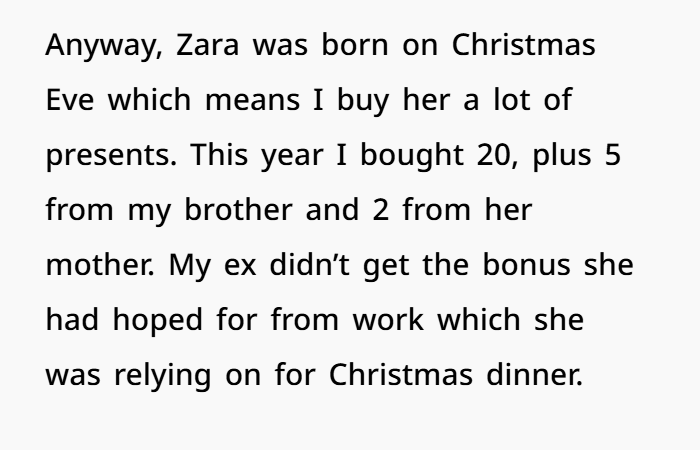
First off, let’s be clear: OP didn’t do anything inherently wrong by giving his daughter a lavish birthday-Christmas combo. Zara is his daughter, and he has majority custody. He clearly wanted to make her feel special, and in his mind, the gifts were a reward for her good behavior—fair enough.
But the issue arises when those gifts are opened in front of Zara’s 5-year-old half-brother. This is where the emotional complexity kicks in. The half-brother doesn’t have the adult context that Zara’s gifts are specifically tied to her behavior and special occasions. All he sees is his sister opening a pile of gifts while he only has a single book. The perception of fairness, especially for a young child, is incredibly important in situations like this.
In this case, emotional inequality emerges, not because OP wanted to spoil his daughter, but due to the circumstances. The son is too young to understand that Zara’s gifts are not a part of a shared holiday tradition, and he doesn’t have the emotional maturity to grasp the nuances of the situation. All he knows is that he feels left out, which is a common emotional response for young children in similar situations.
Emotional Fairness and Perception vs. Principle
The real problem here isn’t the number of gifts, but the emotional impact of seeing a sibling receive so much while they have so little. For kids, perception matters more than the principle behind the gifting. It’s not about the “why” or the “how,” but the immediate feelings of inequality. While Zara might understand that her gifts are tied to her birthday and her behavior, her half-brother only sees a disparity that’s hard for him to process.
At that young age, kids are still developing their sense of fairness and justice. When one child receives 27 gifts, it can easily feel like the other child is being treated unfairly—even if the reasoning behind the gifts is sound to an adult. It’s a tough situation where, despite OP’s good intentions, the emotional outcome doesn’t align with what he likely wanted to achieve.
Co-Parenting Ethics and Family Dynamics
This situation also shines a light on the complexities of co-parenting and family dynamics. The ex’s request to “celebrate as one family” is, in itself, an indication of the unresolved tension and expectations that still exist between her and OP. Despite their non-romantic relationship and years of conflict, the ex’s desire to blend families without clear boundaries could be what triggered the problem.
OP’s decision to respect Zara’s wishes (that her half-brother could not touch her things) was an important boundary to set. Zara had every right to express that desire, and OP was right to respect that boundary. But that decision, coupled with the way the gifts were presented, created a moment where emotions, rather than logic, took the lead.
The ex’s insistence on treating it all as one family celebration, despite the lingering issues, didn’t take Zara’s feelings or the emotional complexity of the situation into account. It placed the focus on blending families in a way that didn’t align with the emotional reality of the kids involved.
The Child Psychology Angle
From a psychological standpoint, children at these ages are still learning how to navigate the complexities of family dynamics, boundaries, and fairness. Zara’s half-brother, at 5 years old, likely doesn’t understand the emotional subtleties of birthday celebrations, parental custody, or behavior-based rewards. All he knows is that he feels left out and confused by the stark contrast in the number of gifts.
Meanwhile, Zara might be thrilled by the attention and gifts, but her ability to empathize with her half-brother’s feelings is still developing. Even if Zara has a strong emotional understanding of why she’s receiving gifts, the optics of the situation are still powerful. Seeing her brother possibly feel neglected or upset could create a strain on their sibling relationship down the line, as kids often internalize these moments of perceived inequality.
Holiday Expectations and Boundaries
The holiday season is always full of heightened emotions. For OP, it was a chance to celebrate his daughter, but for the ex, it was also a time to try and create some sense of normalcy or family unity. OP was right to stand his ground and honor Zara’s wishes, but the issue here is that holiday expectations often don’t align with the realities of co-parenting and sibling relationships in blended families.
The request to treat this as “one family” is an example of how holiday expectations can sometimes clash with the emotional boundaries that need to be in place for everyone to feel respected. OP’s decision to respect Zara’s feelings while also navigating his ex’s pressure was a delicate balance, but in the end, he made the right call.
Conclusion
In this case, it’s not about the number of gifts or even about being “fair” in a traditional sense. It’s about the emotional experience of all the children involved and the need to respect boundaries while navigating complex family dynamics. OP didn’t do anything wrong by giving Zara a special Christmas and birthday celebration, but he did face the consequences of a situation where emotional fairness and the realities of co-parenting collided.
OP’s choices reflect a deeper understanding of what’s best for his daughter’s emotional health and well-being, even if it caused temporary discomfort for others. Ultimately, it’s a challenging situation, but OP made a decision based on what was best for Zara, her emotional needs, and her sense of fairness—something that’s often overlooked in complicated family dynamics.
Was It OP’s Responsibility to Include the Half-Brother?

Legally? Morally? No.
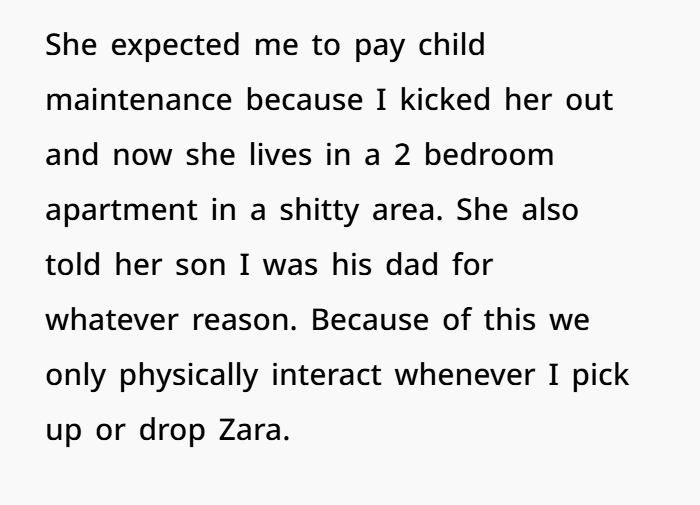
This situation is complicated, and it’s easy to see why OP feels torn. Let’s be real: this child is not his. OP didn’t sign up to parent him, and that’s a fundamental aspect of the story. The ex’s behavior—lying to her son about OP being his father, expecting OP to act like a stepdad, and then calling him selfish when he doesn’t—feels manipulative and unfair. OP isn’t obligated to be a father figure to a child that isn’t his, and it’s understandable that he set clear boundaries when things started to cross into uncomfortable territory.
However, while OP had every right to say no to sharing the gifts, it’s important to acknowledge that the little boy’s Christmas was probably really painful. But that pain wasn’t caused by OP’s refusal—it was a result of the choices his mother made. She’s the one who:
- Misled her son about OP being his father
- Refused to go to her other son’s house so she could have both kids together
- Brought her son to OP’s home, knowing full well he’d be overshadowed by Zara’s birthday and Christmas gifts
The mother set her son up to feel rejected, but the consequence of that setup unfolded in OP’s living room, and everyone felt it—especially the boy. It’s a painful reality that OP didn’t create, but he still had to navigate.
Kids Are Not Emotional Shields
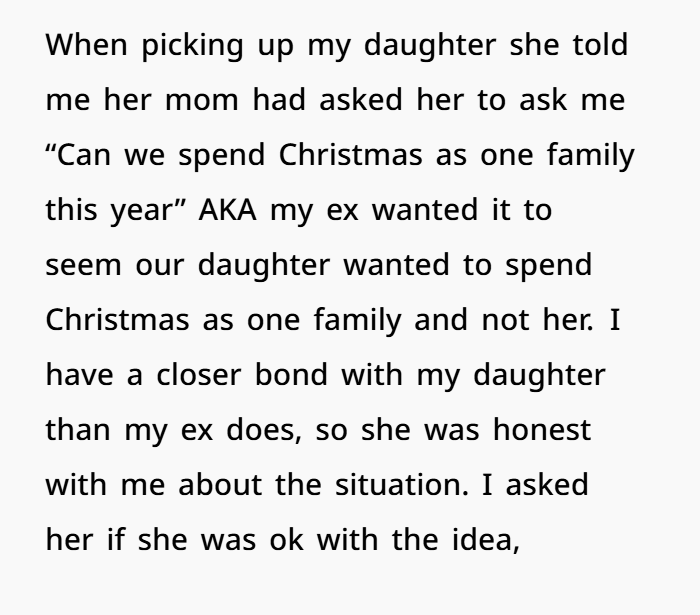
One of the most crucial points here is how the ex used her son as an emotional pawn. Whether she did it intentionally or not, her actions set him up to feel neglected and overshadowed. The ex didn’t want to spend Christmas alone, nor did she want to miss out on seeing her daughter on her birthday, so she framed the situation as a “family” request, knowing the kids didn’t share a close sibling bond. She asked Zara to pass on the message, putting the pressure on her, not herself.
That alone speaks volumes about the ex’s emotional priorities: her convenience and desires came first, and the kids’ emotional needs came second.
When people say “but the boy’s just a child,” they’re absolutely right. But OP is also not responsible for that child’s happiness. The emotional labor falls on the mom, and she dropped the ball. She should’ve considered the emotional impact of bringing her son into a situation where he would feel neglected, overshadowed, and out of place. It’s not OP’s fault that the boy felt left out—it’s the ex’s for creating a scenario where he had to deal with that disappointment.
Promises Matter—Especially to Kids
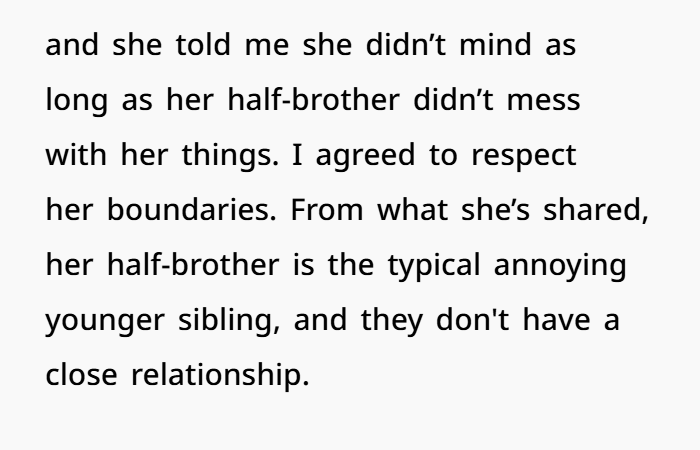
Zara expressed a boundary, and OP respected it. She said her half-brother could come, but she didn’t want him touching her things. That’s not cruelty; that’s a 7-year-old asserting autonomy over her belongings. In co-parenting, this kind of respect is crucial—it builds trust between parent and child. Zara’s request wasn’t unreasonable; it was a healthy boundary, and OP honored it.
To have suddenly forced Zara to share her gifts just to avoid an awkward moment would’ve violated that trust. Zara might not fully understand the adult dynamics at play, but she would have understood that her feelings were being dismissed. That would’ve sent a message: “Your comfort doesn’t matter if it makes someone else cry.”
And that’s a dangerous message to send to any child, especially a young girl. It teaches that her feelings and boundaries are less important than keeping someone else comfortable—an idea that can lead to long-term emotional consequences. Girls especially need to know that their comfort and boundaries matter, and OP did the right thing by standing firm in protecting them.
Conclusion
In the end, OP is not the asshole. He set clear, fair boundaries for his daughter and respected her wishes, which is what any responsible parent should do. The ex, however, made choices that set her son up for emotional discomfort, and that’s where the real problem lies. It’s not OP’s fault that the boy felt hurt—it’s the ex’s for putting him in an emotionally untenable position.
While empathy for the boy’s pain is important, OP’s priority had to be his daughter’s comfort and emotional safety, and that’s exactly what he did. When you’re co-parenting, it’s important to respect children’s boundaries and let them feel heard. In this case, OP’s actions were not about cruelty, but about teaching Zara that her comfort matters—an essential lesson, especially for young girls.
Co-Parenting Isn’t Always Equal—and That’s Okay

Let’s be real: OP’s life is on a different trajectory than his ex’s. He’s financially stable, he has more time with Zara, and he enjoys a better relationship with her. None of that is a crime, but when co-parents have significant lifestyle gaps, it can feel like every shared holiday becomes a wealth contest—and that’s not just about money, it’s about emotional presence.
OP shows up for his daughter. He’s there for the milestones, the birthdays, the special moments. His ex tries, but she carries a lot of emotional baggage into these situations. The resentment she feels likely isn’t really about the gifts—it’s about the fact that her child prefers being with his father. And when it comes to big holidays like Christmas, that hurt hits differently. But that’s not OP’s responsibility to fix, nor should it be.
Was OP Too Harsh?
Honestly? Not really.
OP didn’t humiliate the boy or mock the ex. He simply enforced a boundary his daughter set, which is something every parent should do. Zara made it clear that she didn’t want her half-brother touching her things. OP honored that boundary and stuck to it. That’s not harsh—it’s parenting.
Could he have let his brother give the boy some money or slipped him a small toy to ease the tension? Sure. It might’ve defused the immediate discomfort. But doing so would’ve sent a mixed message to Zara. It could’ve implied that her feelings and boundaries were less important than avoiding an awkward moment. It could’ve made her feel guilty for standing up for herself. OP was right to avoid making his daughter feel like she had to sacrifice her own comfort to keep the peace.
At the end of the day, the ex brought emotional fire into what should’ve been a joyful situation. She created an environment where her son felt left out, and then blamed OP for not putting out that fire. But this wasn’t OP’s fire to put out—it was her responsibility to manage her own emotions and ensure that her son’s experience was positive, not overshadowed by unresolved resentment and frustration.
OP didn’t cause the hurt feelings. The ex did. And while empathy for the boy is important, OP’s priority had to be Zara’s emotional well-being and the respect of her boundaries. This wasn’t about cruelty; it was about maintaining consistency, respect, and fairness for Zara in a situation fraught with emotional complexity.
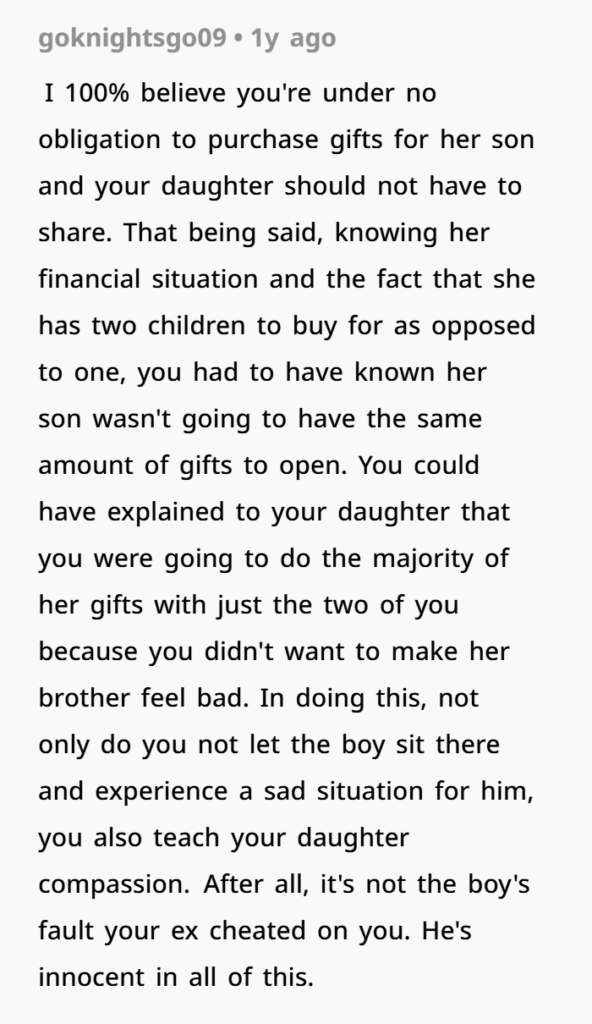
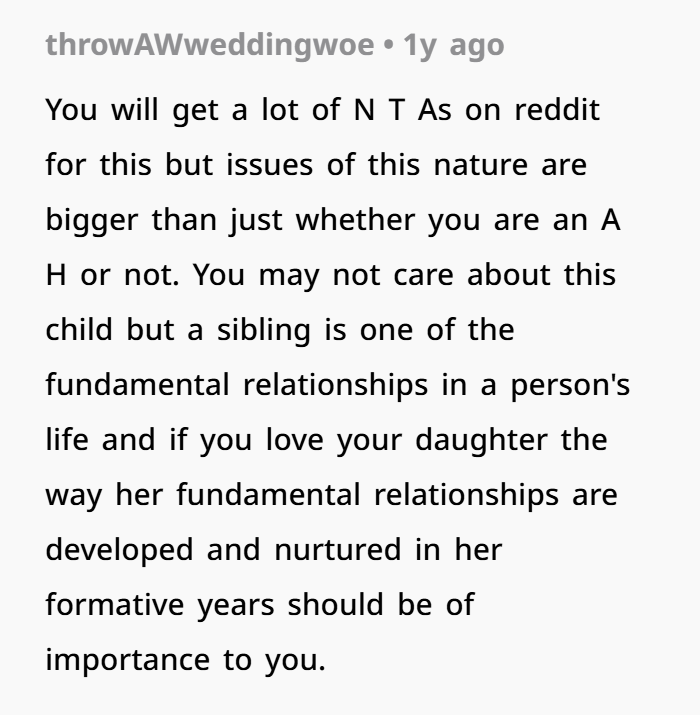
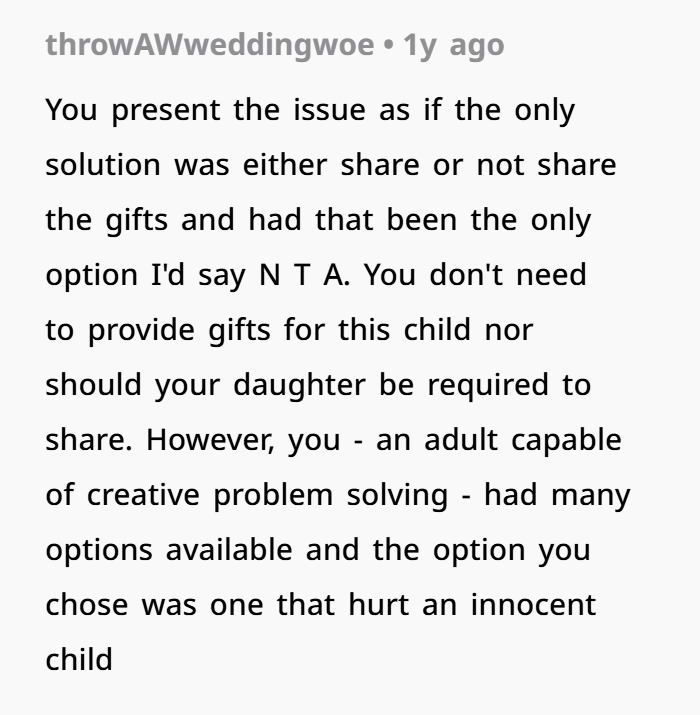
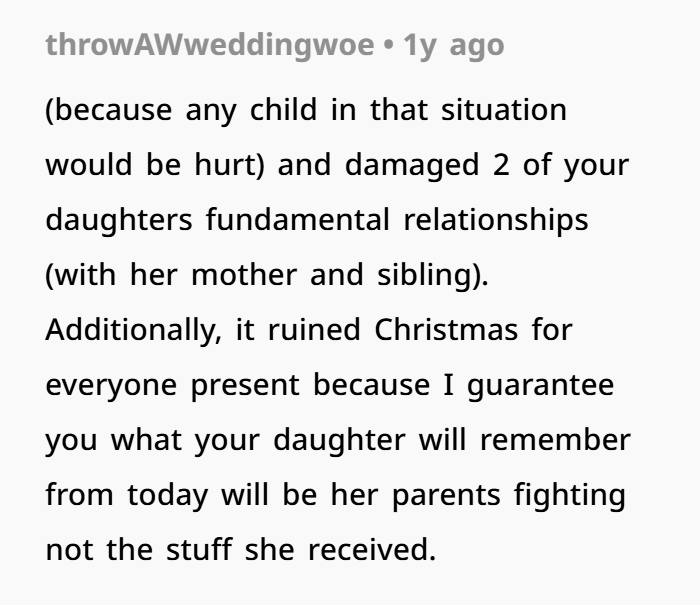
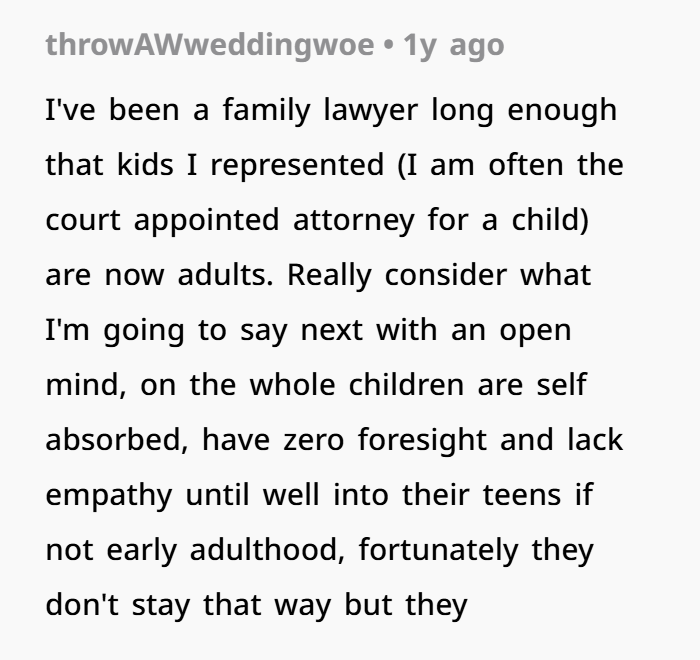
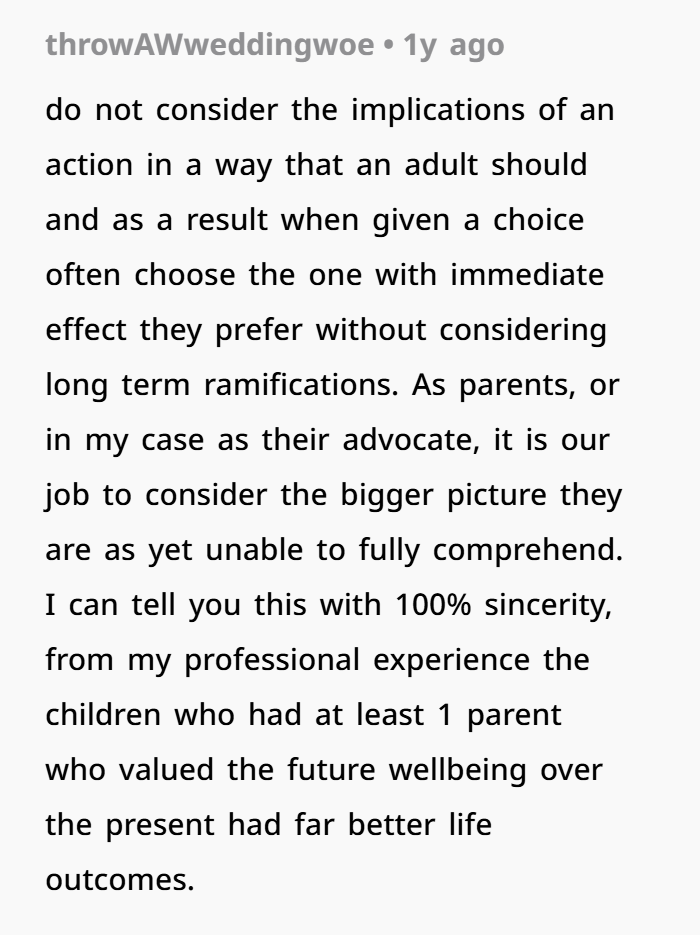
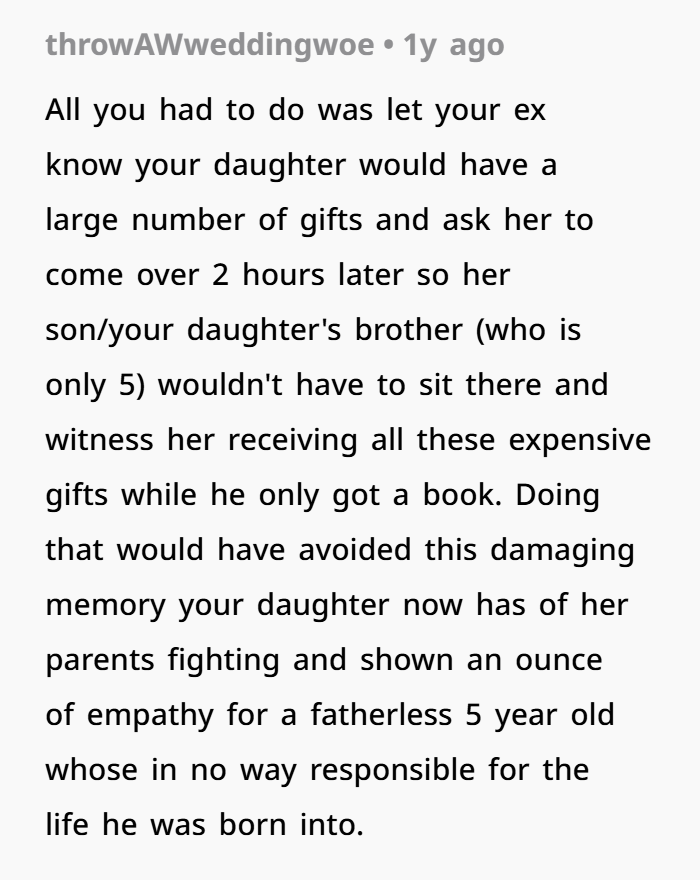
Most people agreed he was not obligated to buy the boy gifts, but he should have shown more compassion

No, you’re not the a**hole. You’re a parent who showed up, respected your daughter, and refused to be emotionally manipulated by your ex’s guilt trip.
Your job is to protect and celebrate your child—not to be the emotional Band-Aid for someone else’s broken choices.
This wasn’t about 27 gifts. It was about respecting a child’s boundaries and not allowing guilt to override them. You stood by your daughter’s needs, which is exactly what a responsible, loving parent should do. The ex tried to create a situation that would make you feel responsible for everyone’s feelings, but in the end, you prioritized what was best for Zara. And that’s what truly matters.