Man Completely Snaps After SIL Stands Up to Him, Wife Gets So Scared She Runs to Her Parents
Family dinners can often be filled with awkward small talk and uncomfortable moments, but for one woman, Thanksgiving became the tipping point after years of enduring passive-aggressive “jokes” at the expense of her younger brother.
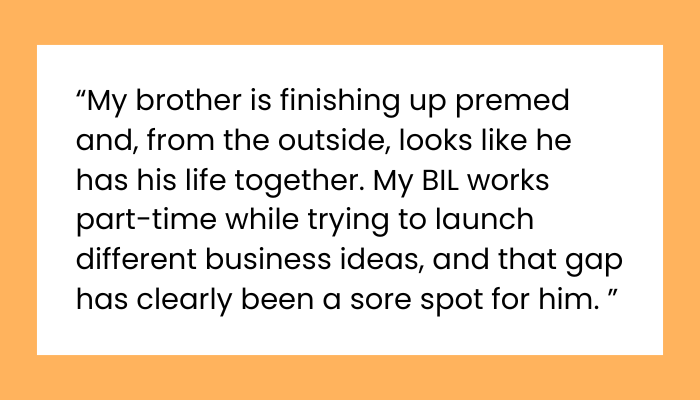
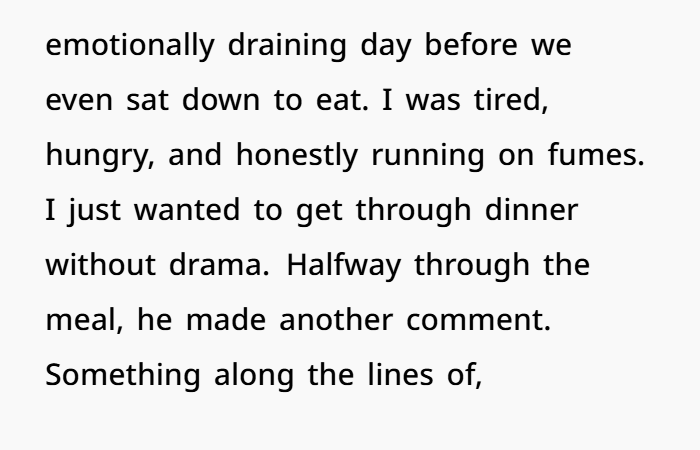
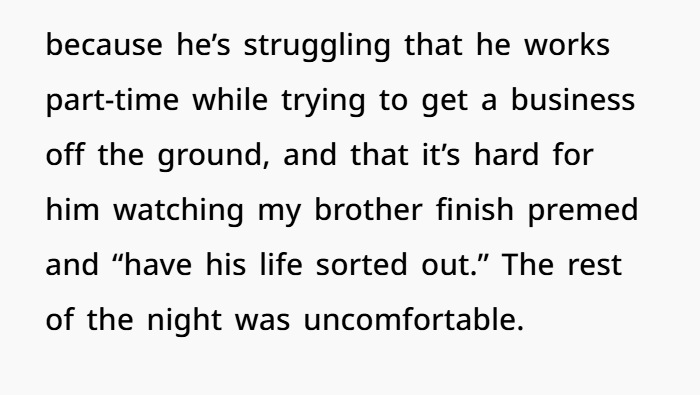
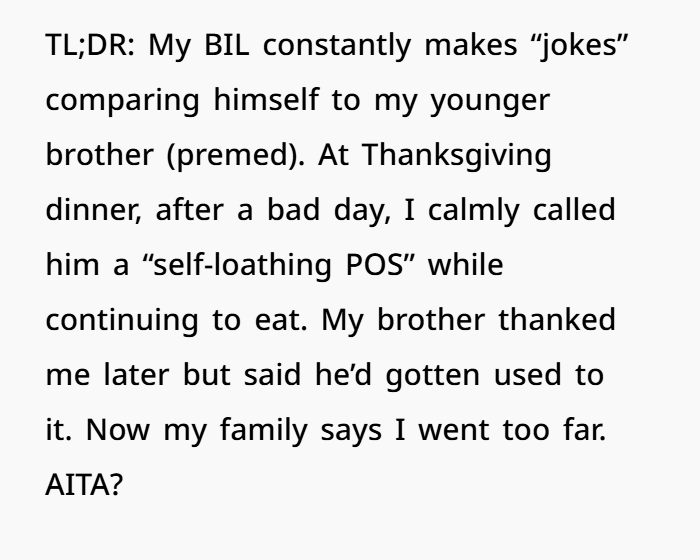
OP (27F) had spent years listening to her brother-in-law (BIL) (32M) make snide comments about her younger brother (22M), who is focused on his premed studies and seems to have a clear path ahead. In contrast, her BIL works part-time and is still trying to get a business off the ground. While some people may express insecurity through jokes, her BIL’s ongoing behavior finally pushed OP to speak up.
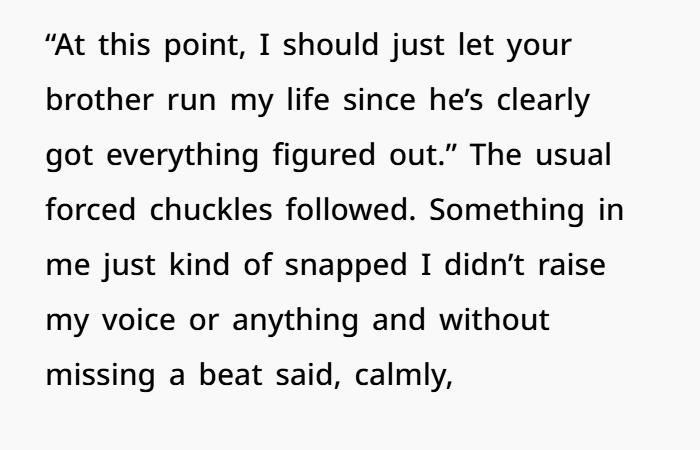
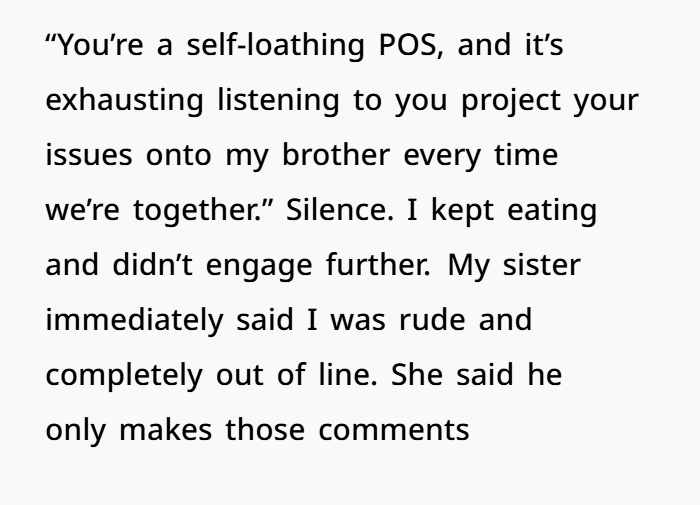
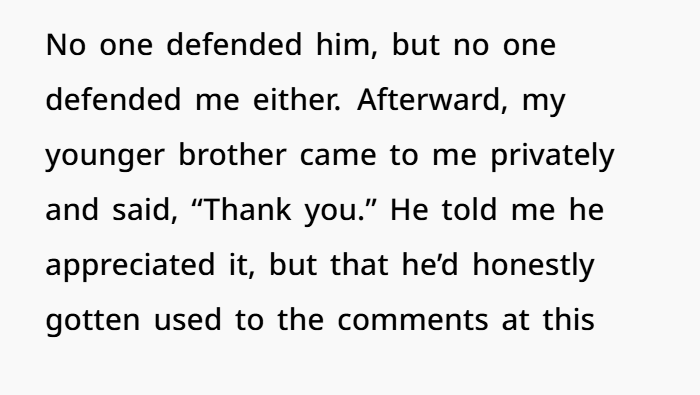
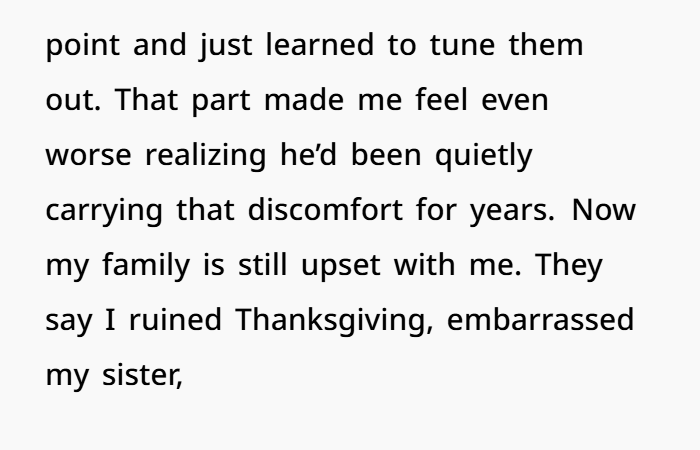
At Thanksgiving dinner, after another comment about her brother “running his life,” OP calmly called her BIL a “self-loathing POS” and continued eating. The room fell silent, and shocked faces filled the space. Her sister, upset, accused OP of cruelty, but behind closed doors, her brother quietly thanked her. Those “jokes” had hurt for a long time, and he had simply learned to live with them.
In the end, standing up for family in a moment of tension can be challenging, but it also sends a powerful message about protecting loved ones from unnecessary hurt.
Sometimes, the happy vibes during a holiday can instantly disappear because of bitter family drama
The poster’s 32-year-old brother-in-law always mocked her 22-year-old brother for having his life “sorted,” and did it again during Thanksgiving dinner
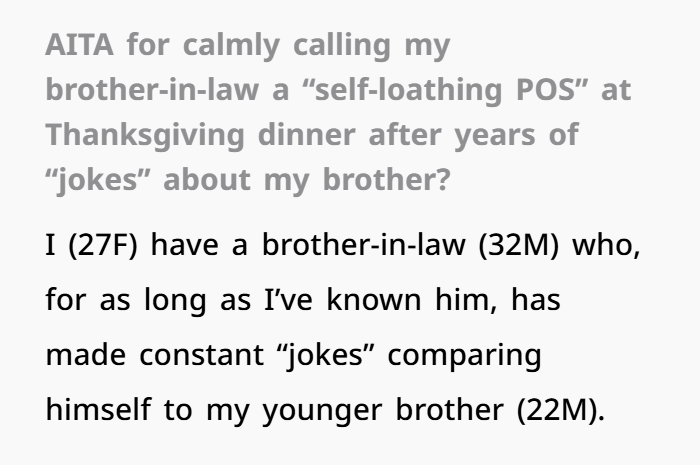
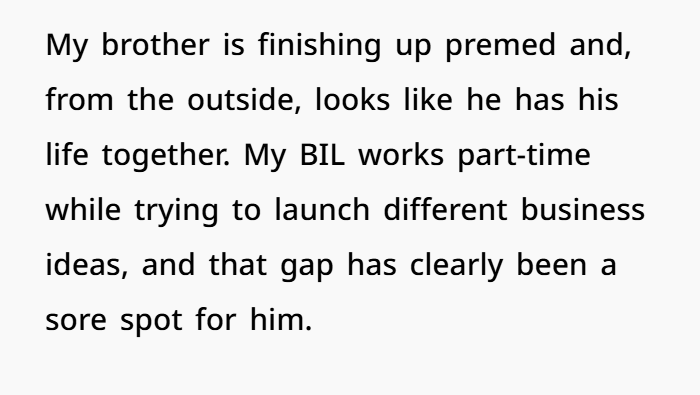
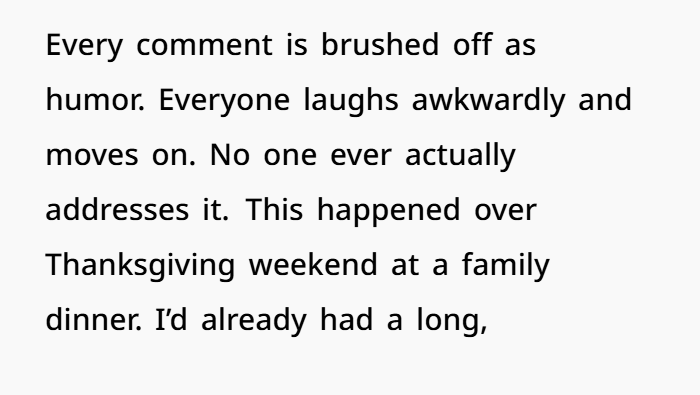
Let’s be real: Families often have their own unique language. Some express love through sarcasm, while others use humor to deflect tension. But there’s a fine line between playful teasing and emotional microaggressions—especially when those “jokes” are repeated, one-sided, and always at someone else’s expense.
And that’s exactly what this story sounds like—death by a thousand “jokes.”
When Insecurity Turns Toxic
Let’s take a moment to talk about the brother-in-law. He’s 32, struggling to launch a business, and dealing with the challenges of finding his path. That’s tough, and there’s no shame in taking a non-traditional route or figuring things out later in life. But when those struggles turn into resentment—particularly toward someone a decade younger—it becomes a problem.
His “jokes” aren’t really jokes at all. They’re subtle digs meant to make him feel better by putting someone else down. And when that someone is a 22-year-old college student who hasn’t even entered the workforce yet? It reeks of jealousy, not humor.
Every time he says, “Well, I guess your brother has life figured out,” what he’s really saying is: “I feel inadequate. And I need everyone to know it so they won’t expect much from me.”
That’s not funny. That’s projection.
The Power of a Calm Clapback
What makes OP’s moment at Thanksgiving so memorable isn’t just the line—it’s how she delivered it. She didn’t shout. She didn’t create a scene. She calmly called him a “self-loathing POS” and kept eating, acting like it was no big deal.
That’s not cruelty. That’s emotional precision.
Calling someone a “self-loathing POS” is strong, yes—but it hit home because everyone in that room knew it was true. No one defended him. There wasn’t a chorus of “That’s unfair!”—just stunned silence. And that silence? It speaks volumes.
The only person who reacted was OP’s sister. And honestly, that’s understandable. She’s likely embarrassed, feels protective of her partner, and might be struggling with the uncomfortable truth that everyone has been quietly tolerating him instead of truly enjoying his company.
But that doesn’t mean OP was wrong.
Let’s Talk About “Keeping the Peace”
“Just keep the peace” is a phrase often thrown around in family settings. But here’s the thing—peace isn’t real if it only exists at someone else’s expense.
In this situation, the so-called “peace” came at the cost of the younger brother’s discomfort. He was the silent punchline at every dinner, forced to smile through comments that made him feel small. That’s not peace—that’s appeasement. OP finally broke that cycle.
People like the BIL thrive in families where everyone’s too polite to call them out. His behavior continued because no one checked him. OP finally did—and that’s what true support looks like.
Emotional Gaslighting: It’s Not Just Loud
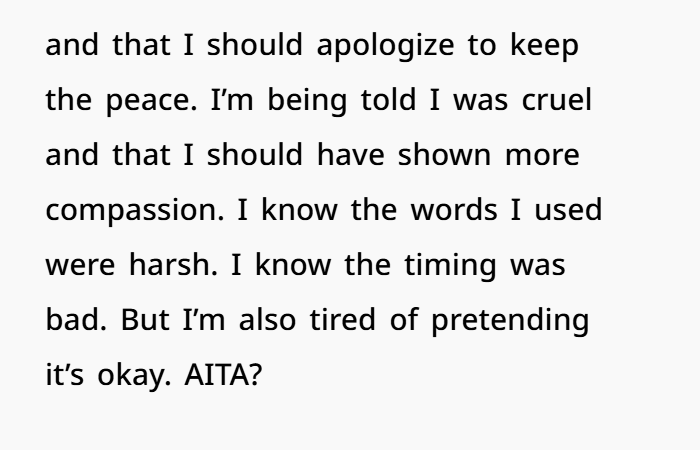
The reaction OP received from her family—especially her sister—can be seen as emotional gaslighting. The blame shifted from the BIL, who was causing discomfort, to OP, who called it out.
“You embarrassed us.”
“You should’ve been more compassionate.”
“You ruined Thanksgiving.”
This is a classic tactic in dysfunctional family dynamics: shift the blame to the person who spoke up, not the one who created the problem. It’s a way to avoid facing the uncomfortable reality of a family member’s hurtful behavior.
OP’s brother thanking her privately is a clear sign. He had silently endured these comments for years, but no one noticed—or worse, no one cared. The fact that OP spoke up, uncomfortable as it may have been in the moment, made him feel seen.
And honestly? That moment is worth more than any awkward holiday dinner..

Could She Have Handled It Differently?
Sure, she could’ve pulled him aside privately. Or talked to her sister before dinner. Or softened the language a bit.
But here’s the thing—years of silence already failed. A more polite approach might’ve been easier to digest, but it probably would’ve been brushed off again. The power of calmly speaking a harsh truth, publicly, in the moment? That’s what made it stick.
She didn’t attack his dreams. She didn’t call him lazy. She called him out for projecting his insecurity—and that’s exactly what he was doing.
Folks online didn’t shy away from calling out the brother-in-law’s behavior, and many claimed that he was a massive red flag
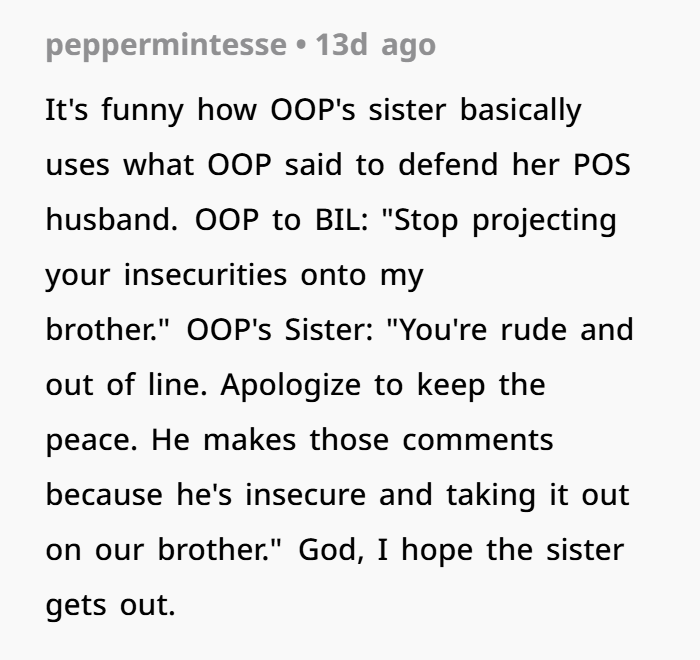
No, OP isn’t the AH. She’s the only one in that family who stood up for her brother. She didn’t do it for drama or to lash out. She simply called out a pattern that had gone unchecked for years. And sometimes, that’s what love looks like—messy, blunt, and brave.
So yeah, Thanksgiving was awkward. But maybe—just maybe—it needed to be.