MIL Secretly Gives Baby Formula Behind Mom’s Back, Claims “He Was Starving” When Confronted
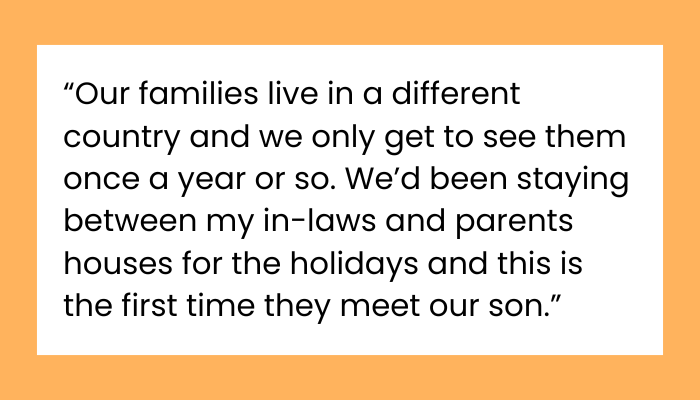
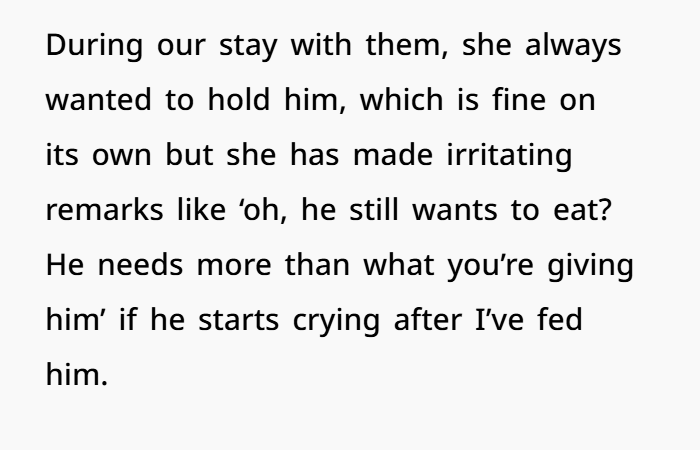
You’re a mom of two, visiting family overseas, and already feeling vulnerable. It’s the first time everyone’s meeting your newborn son, and you don’t see your family often. From the start, your mother-in-law (MIL) is overly fixated on your baby. She’s sending constant messages, calling him her baby, questioning your parenting choices, criticizing your breastfeeding, and undermining the way you soothe him.
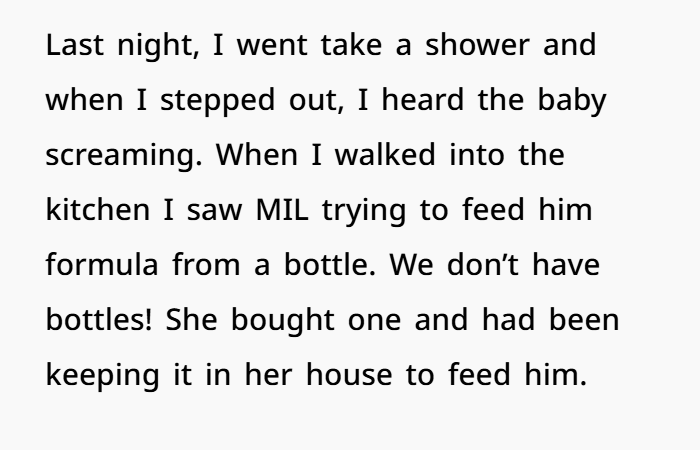
Then, you step into the shower. When you come out, your baby is crying, and there she is—feeding your exclusively breastfed 3-month-old formula from a bottle she secretly bought and hid in her house. No consent. No discussion. No emergency—just her deciding she knows better than you.
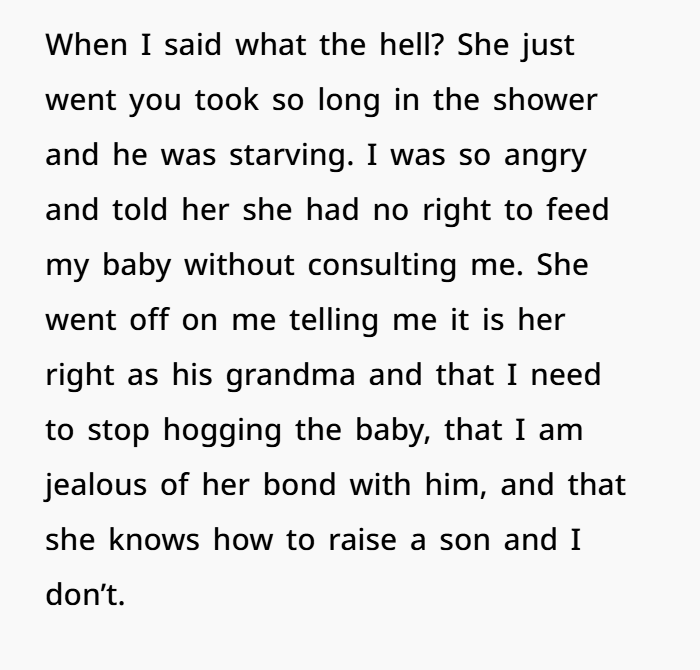
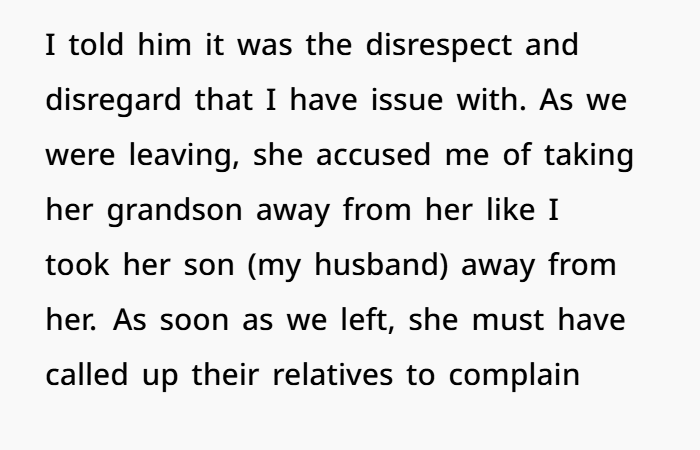
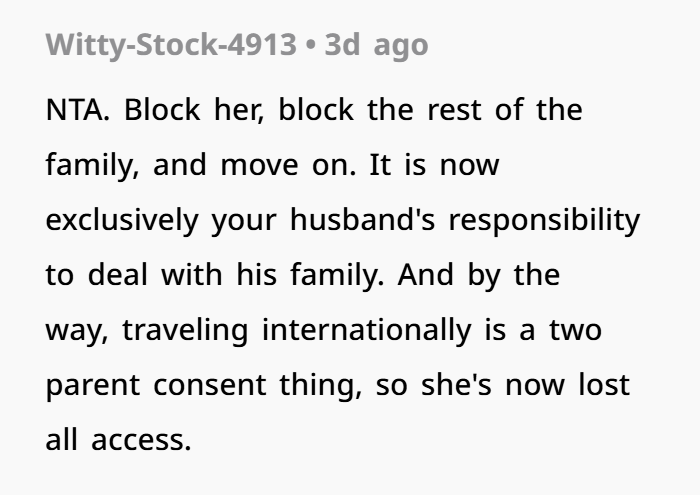
When you confront her, instead of apologizing, she turns it around and attacks you. She claims it’s her right as a grandmother, accuses you of being jealous, and insists that she knows how to raise a son better than you do.
Woman catches MIL feeding baby without her consent

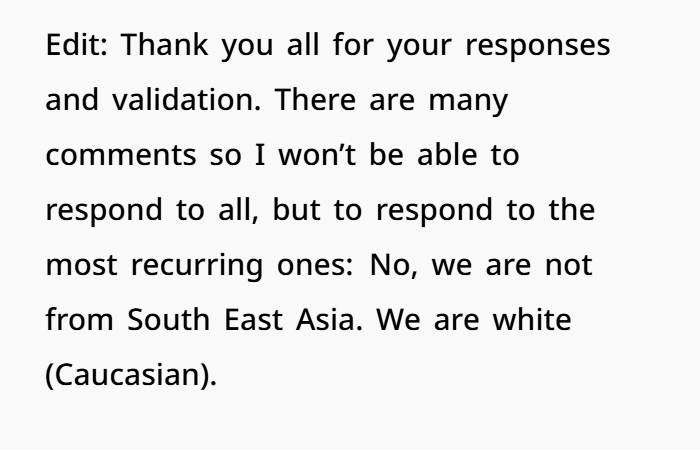
She talks about interference and judgment from her in-laws
Exactly—this situation isn’t about formula versus breastfeeding. It’s much deeper than that.
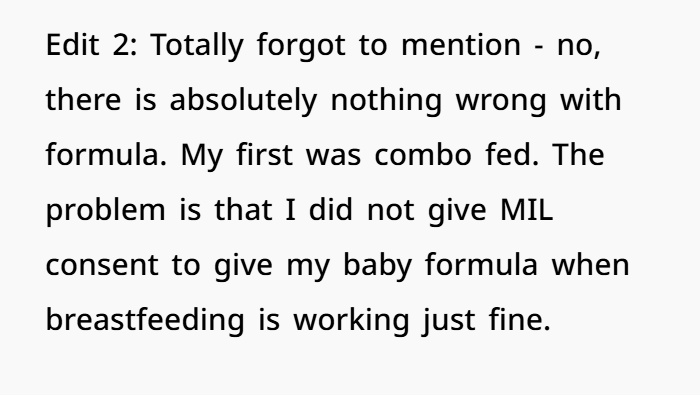
You’ve already made it clear that you’re not against formula—you combo-fed your first child, and you’re not making a blanket statement against formula feeding. The real issue here is about consent, control, boundaries, and respect. Your MIL’s actions didn’t just overstep, they disregarded your authority as a mother, and that’s something that goes beyond what’s in the bottle.
1. Consent and Control: A Breach of Trust
When your MIL decided to feed your exclusively breastfed 3-month-old formula without your consent, that wasn’t just a mistake—it was a deliberate decision to control the situation. She didn’t ask for your permission, nor did she have an emergency that required her to intervene. She took matters into her own hands because she felt entitled to make parenting decisions for your child, regardless of your wishes.
This is where the core issue lies: control. Parents—you and your partner—are the ones responsible for making decisions about your child’s care. This doesn’t just apply to feeding—it applies to all decisions around your child’s well-being. When someone disregards that and makes a decision behind your back, it undermines your authority and your autonomy as a mother.
2. Boundaries and Respect: Violating Parental Authority
Your MIL didn’t just overstep with feeding the baby; she disrespected your boundaries in multiple ways. From the constant questioning of your parenting choices to criticizing your breastfeeding, she’s been undermining your role as a parent since the moment you arrived. Her behavior doesn’t just reflect a difference of opinion—it’s a lack of respect for your choices as a mother.
You’ve already proven that you’re capable of making informed decisions for your child. Your boundaries around breastfeeding and care deserve to be respected. Instead, your MIL has treated your boundaries as optional, and that’s where the real problem lies. She didn’t just disagree with your approach—she disregarded it completely.
3. Postpartum Mental Health and Family Conflict
Let’s also consider the postpartum aspect. Having a newborn is already an emotionally and physically draining experience. You’re in a vulnerable place, and the last thing you need is to deal with family drama and boundary-pushing from someone who should be supporting you. Instead of being there for you, your MIL’s actions added stress to your already demanding situation.
Postpartum mental health is a delicate thing, and when you’re dealing with family conflict on top of everything else, it makes things harder. You’re not just managing the baby’s needs—you’re also trying to care for yourself, protect your peace, and maintain your mental well-being. When your MIL undermines your authority, it only adds to the mental load you’re already carrying.
4. Toxic In-Laws and Marriage Dynamics
This isn’t just about your MIL’s behavior—it’s also about how this conflict affects your relationship with your partner. Family dynamics, especially when it comes to in-laws, are often tricky. When one partner feels unsupported or undermined, it creates tension not just with the in-laws, but within the marriage as well.
You’re navigating a tricky situation—you need your partner’s support, but he might not be aware of just how deeply his mother’s actions are affecting you. This can lead to feelings of isolation, especially if your partner isn’t stepping up to set boundaries with his mother or fully acknowledge your feelings in the situation.
5. The Bigger Picture: Parental Rights and Autonomy
At the core of this issue is your right as a parent to make decisions about your child’s care. Your MIL doesn’t have the right to make decisions for your child without consulting you, especially when it comes to something as personal and important as feeding. She may have her own opinions, but she doesn’t get to override your choices just because she’s a grandmother.
This is a foundational issue: when it comes to raising your child, your authority as a parent should be undeniable. Her actions reflect a blatant disregard for this fact. The bigger issue here is that this goes beyond just the feeding decision—it speaks to a deeper lack of respect for your role as a mother and for your parenting rights.
Moving Forward: What Needs to Happen
- Set Clear Boundaries with Your MIL
You need to have a clear conversation with your MIL about boundaries—specifically around decisions regarding your child’s care. Be firm and clear that you make the decisions, and any future actions that disregard your authority will have consequences. - Communicate with Your Partner
Ensure your partner understands how his mother’s actions have impacted you and your mental health. He needs to step up in supporting you and setting boundaries with his mother to prevent future issues. This isn’t just about you—it’s about the well-being of your family as a whole. - Self-Respect and Emotional Safety
Make sure you are protecting your emotional safety. This means enforcing your boundaries and not allowing anyone, even family, to disrespect or undermine your parenting decisions. You have every right to protect your role as a mother and demand that others respect your choices. - Assert Your Parenting Autonomy
What happened with the bottle is inexcusable. Reaffirm your role as the primary decision-maker when it comes to your child’s care. This situation should serve as a wake-up call to both your MIL and your partner about respecting your autonomy.
Conclusion: Protecting Your Family’s Well-Being
You deserve to feel supported, respected, and empowered as a mother. What you’ve experienced with your MIL is not just about differing opinions—it’s about overstepping boundaries and disregarding your rights as a parent.
Moving forward, it’s important that you assert your parental autonomy, protect your emotional health, and demand respect from both your MIL and your partner. Creating a strong, united front in these matters will help you protect your family’s well-being and avoid future conflict.
1. Feeding a Baby Without Parental Consent Is a Huge Violation

This situation is deeply troubling, and it’s important to clearly address what happened. What your MIL did is not just about a feeding choice—it’s about undermining your role as a parent and disregarding your authority in the most personal and sensitive area of your life: how you care for your child.
1. Parental Override: A Serious Breach of Trust
Feeding an infant is a fundamental parenting decision, not something that anyone else has the right to override, especially not a grandparent. Your MIL’s actions went beyond offering unsolicited advice—she made a secret decision without consulting you or considering your parental authority.
What she did was:
- Buy a bottle and formula in secret.
- Wait until you were alone and vulnerable, in the shower, and then take the opportunity to feed your baby formula without your knowledge.
- Justify her actions rather than apologize or acknowledge the wrong.
This isn’t “helping” or offering support—this is undermining your role as a parent. In parenting terms, this is called parental override, and it’s one of the most damaging things an extended family member can do. It completely disrespects your authority and undermines your decisions about your child’s care. This isn’t just a minor disagreement—it’s a serious violation of boundaries.
2. “It’s My Right as a Grandma” Is Not a Thing
Her statement, “It’s my right as a grandma,” is not just misguided—it’s deeply concerning. Grandparents do not have the right to make decisions about feeding, sleep routines, or anything else related to raising your child. Parents have rights, not grandparents.
Being a grandmother does not grant authority over:
- Feeding choices
- Medical decisions
- Attachment practices
- Bonding moments
This mindset—that grandparents have a right to dictate how a child is raised—shows a lack of respect for you as a primary caregiver and decision-maker. It’s an issue of control, not care, and if this belief is not addressed, it will likely escalate. This isn’t a harmless misunderstanding; it’s a fundamental issue of parental authority.
3. The Breastfeeding Comments: About Control, Not Concern
Now, let’s discuss her obsession with breastfeeding. When someone truly cares about your well-being as a mother, they support you in your choices. They ask how they can help or offer to take a load off. But that’s not what she was doing.
Her comments weren’t about concern; they were about control. She wasn’t saying things like:
- “Are you getting enough rest?”
- “How can I support you in this?”
- “Would you like help with anything?”
Instead, she was saying things like:
- “He’s never full.”
- “You’re too attached.”
- “He needs more than what you’re giving him.”
These aren’t concerned comments; they are power-struggle comments. They undermine your choices and question your competence as a mother. Breastfeeding already comes with a lot of pressure, and when someone constantly critiques your approach, it adds emotional weight you don’t need.
And then, to top it all off, she proved exactly what those comments were about by taking matters into her own hands and feeding your child formula behind your back. It wasn’t about what was best for the baby—it was about asserting her power over your parenting.
4. Moving Forward: Protecting Your Role as a Parent
The emotional toll this has likely taken on you cannot be overstated. You are the mother—your decisions about your child’s care should be respected. When anyone, especially family, crosses these boundaries, it’s important to take action. Here’s what needs to happen:
- Set Clear Boundaries: You need to communicate firmly with your MIL. Make it clear that your role as a parent is not to be undermined, and she does not have the right to make decisions about your child’s care without your consent.
- Assert Your Authority: Tell her that parenting decisions are yours and your partner’s to make, and that her actions were inappropriate and hurtful. There should be no room for misunderstanding or excuses.
- Partner Support: Ensure that your partner understands the severity of the situation and stands with you in enforcing these boundaries. You should be a united front, and your partner should be involved in communicating with his family about respecting your decisions.
- Protect Your Mental Health: This situation can take a toll on your postpartum mental health and emotional well-being. You have every right to protect your space and your mental health. If necessary, limit contact or set stronger boundaries to protect yourself from further stress or conflict.
5. Conclusion: Reclaiming Your Power
At the end of the day, this isn’t just about a feeding decision—it’s about respect, boundaries, and control. Your role as a mother deserves to be honored and your choices respected. Your MIL’s actions were disrespectful, and you’re not wrong for feeling upset.
Moving forward, it’s vital that you protect your boundaries as a parent and take steps to ensure that your role as the primary decision-maker is not undermined. You have the right to make the best choices for your child without interference, and you have the right to demand respect in how your parenting is treated by others—especially family.
Your emotional well-being, your autonomy as a mother, and the relationship you have with your child are not negotiable. Stand firm in your boundaries, and take care of yourself and your family.
4. The Emotional Incest Red Flag (“My Baby”)

5. Enmeshment: Not Just a MIL Problem
Calling a grandchild “my baby” now and then can be endearing, but when it becomes a pattern—especially paired with other behavior—it’s no longer harmless.
In your case, your MIL’s obsession with your son and emotional distance from your daughter is a clear red flag. Her accusation that you “took her son away,” the jealousy of your bond with your baby, and her general attitude all point to something deeper: enmeshment.
This isn’t just about her being overly attached to her grandchild—it’s about her seeing herself as central to the family dynamic, with you as competition. She doesn’t view herself as extended family, she views herself as the primary figure, and that means your role is being undermined.
This is not a MIL problem per se; it’s a boundary and identity issue. She has blurred the lines of family roles and overstepped the natural boundaries that should exist.
6. The Gender Difference: A Red Flag
You noticed that she treats your daughter differently. This isn’t insignificant. It suggests favoritism, and potentially gender bias.
When someone favors one child over another, it’s more than just a personal preference—it can lead to long-term emotional damage. Projection of her emotional needs onto your son only adds to the complexity. This behavior isn’t just damaging to your relationship with her—it creates emotional discomfort for your kids.
Favoritism can create deep-rooted sibling rivalry and resentment between children, which can affect their relationship with each other long into adulthood. Your instinct to protect your kids from this dynamic is not just protective—it’s correct.
7. Gaslighting: The “Be Grateful” Narrative
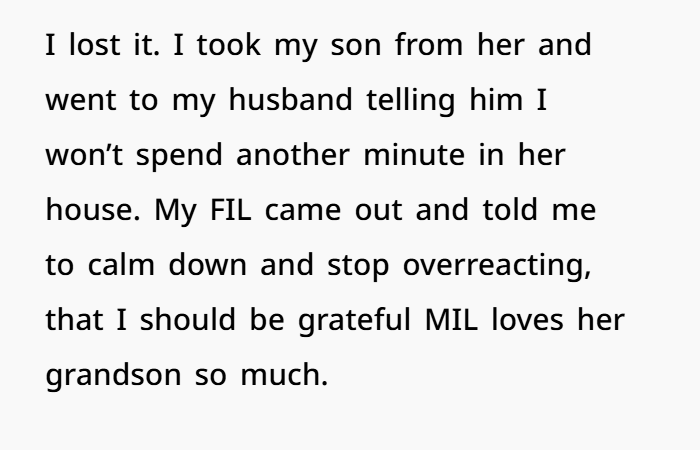
When your FIL said you were overreacting and that you should be grateful, this is classic family gaslighting.
This tactic reframes the situation, saying:
- Her intentions outweigh your boundaries.
- Her feelings are more important than your authority as a mother.
- Harmony is more important than accountability.
What this tactic does is invalidate your feelings and train mothers, especially to tolerate disrespect for the sake of “keeping the peace.” It subtly suggests that your boundaries are secondary to her comfort or feelings, which is both emotionally manipulative and unhealthy.
You did the right thing by not tolerating this. Not falling for it was important, and it’s a step in the right direction for asserting healthy boundaries.
8. Leaving Was the Right Move
Let’s talk about what happened when you walked away.
You did not scream. You did not get physical. You did not insult her first.
Instead, you calmly removed yourself and your baby from an unsafe and disrespectful situation. This wasn’t dramatic—it was protective parenting. You made the decision to remove your child from an environment where their emotional well-being was being compromised.
Sometimes the safest, most mature option in situations like this is to step away and let the other party reflect on their actions. It was the most calm and self-respecting choice you could have made, and it sends a clear message about respecting your authority as a parent.
9. The Smear Campaign Afterward
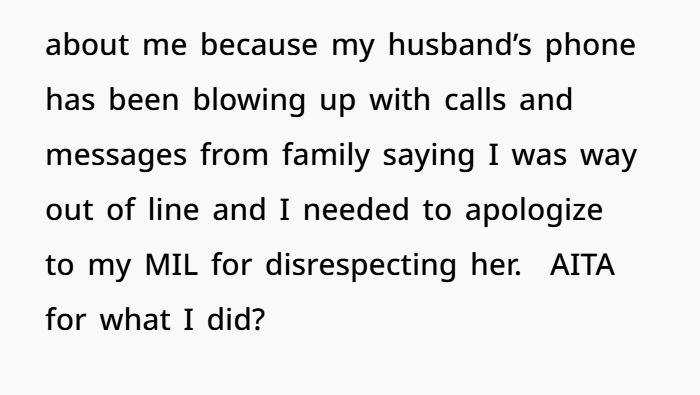
This part is telling. The fact that your MIL immediately went to relatives to try to turn them against you says everything you need to know about her intentions.
People who know they’ve crossed a line typically:
- Apologize
- Reflect on their actions
- Try to repair the relationship
People who know they’ve crossed a line but refuse to take accountability:
- Recruit allies to support their narrative
- Play the victim
- Rewrite the story to cast themselves in a better light
The flood of calls demanding an apology is proof that she is not interested in reflection or accountability. Instead, she’s trying to shift blame and make you out to be the one in the wrong. This is a classic tactic used by people who are emotionally manipulative—they will deflect their own behavior by making you feel like the problem, which is exactly what’s happening here.
Conclusion: You Deserve Respect, and You’re Right to Protect Your Family
You did the right thing by standing up for yourself and protecting your baby. Healthy boundaries are essential in any family dynamic, and it’s clear that your MIL’s behavior needed to be addressed.
It’s important that you continue setting those boundaries and make it clear that disrespect won’t be tolerated. This isn’t just about you—it’s about protecting your children’s emotional safety and ensuring that they’re not exposed to damaging family dynamics.
In this situation, you’re asserting your parental authority, which is your right as a mother. You’re not just protecting yourself—you’re protecting your family and ensuring a healthy environment for your children. Keep enforcing those boundaries, and keep prioritizing your own peace and well-being. You’ve got this.more concerned with control and image than with your trust.
9. The Bigger Issue: Your Husband

This is the hardest part, and it’s crucial to acknowledge: your MIL is the problem, but how your husband reacts will shape the long-term health of your family dynamic.
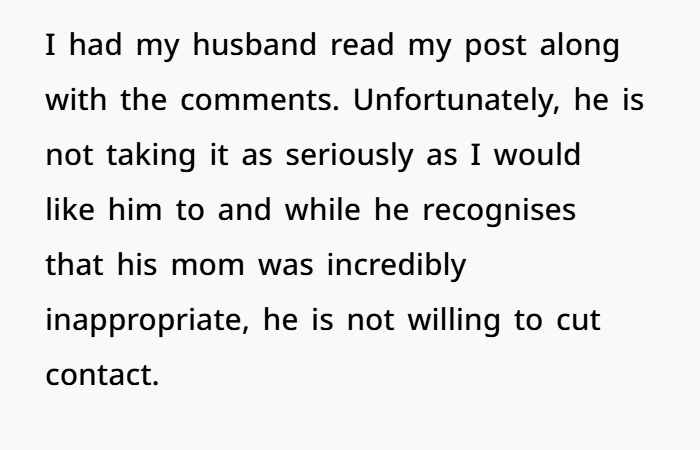
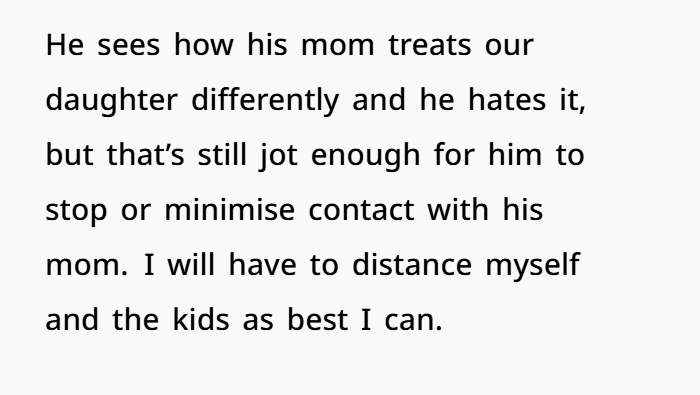
Right now, your husband’s response—while he admits his mother was inappropriate—isn’t enough. He won’t reduce contact, he won’t enforce any real consequences, and he won’t fully protect you or the kids.
This leaves you in a painful and vulnerable position. When one partner stays neutral in a conflict like this, neutrality sides with the aggressor. It means that your MIL continues to overstep without facing any consequences, and your needs as a mother and your boundaries are left unprotected.
1. What You’re Asking for Is Reasonable
You’re not asking your husband to cut his mother off forever. That’s not the point. You’re asking him to defend your parental authority, enforce boundaries, and protect your children from harm. These are reasonable, non-negotiable requests.
As a mother, you deserve respect for your parenting choices, and your husband should be your ally in this, ensuring that his family treats you with the same respect. You shouldn’t have to battle on your own while he remains passive.
It’s not about creating division or punishing his family; it’s about maintaining a healthy, respectful dynamic where your role as a parent is upheld, and your children’s safety and well-being are prioritized.
2. You Are Not “Keeping Her Grandson Away”
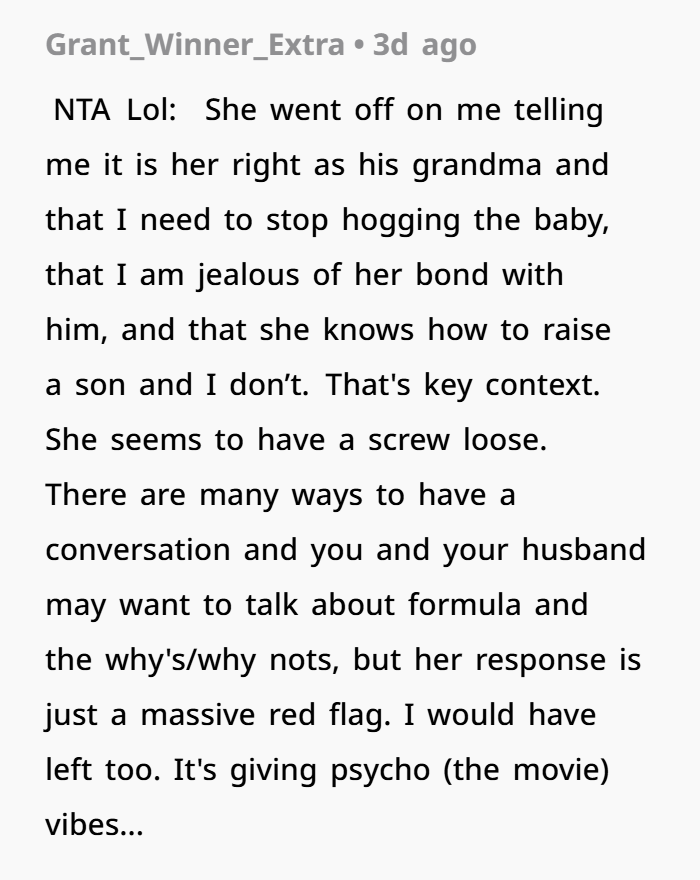
The accusation that you’re “keeping her grandson away” is a classic tactic of emotional manipulation. Let’s be clear: You didn’t take her grandson away. She lost access to him by violating trust and undermining your role as a mother.
Access to children, as it should be in every family, is conditional on respect for parents and their boundaries. Your MIL’s actions created a breach of trust—not just with you but with your child—and you have every right to enforce consequences for that. Your boundaries are not negotiable, and protecting your child from someone who violates those boundaries is not “punishing” anyone. It’s protecting your family.
3. So, Are You the Asshole?
The short answer? No.
You are not the asshole in any sense. You were:
- Disrespected
- Undermined
- Overridden
- Insulted
- Gaslit
And despite all of that, you responded by protecting your baby—which is exactly what any loving mother would do. This isn’t “asshole behavior”. This is motherhood. It’s standing up for your children, asserting your parental rights, and protecting them from those who would undermine your authority.
4. What You Need to Do Next
It’s time to have a serious conversation with your husband. He needs to understand that his failure to take action isn’t just about family drama—it’s about your safety and the emotional well-being of your children. You are not the villain for wanting a healthy, respectful family dynamic.
You deserve support and clarity from your partner. You deserve action from him, not just acknowledgment of the problem. This isn’t about dividing your family—it’s about protecting your space and your role as a parent.
Conclusion
You’re doing the right thing by protecting your child, and you’re not the asshole. Your MIL violated your boundaries, and now it’s time to address those violations with the support of your partner. What you’re asking for—respect, boundaries, and protection—is completely reasonable. Stand firm in your decisions, and make sure your husband knows that protecting your family’s well-being comes first.
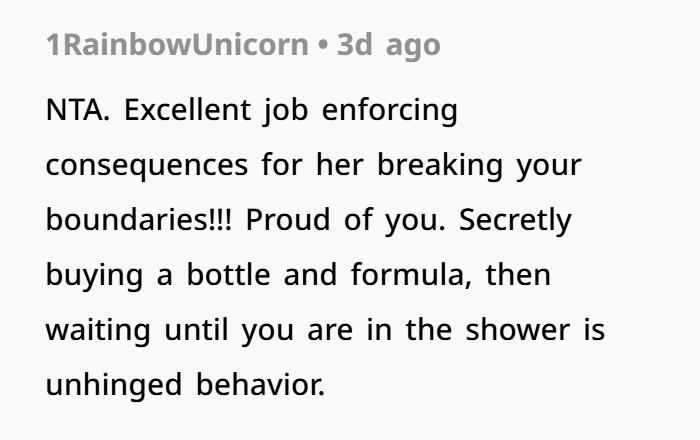
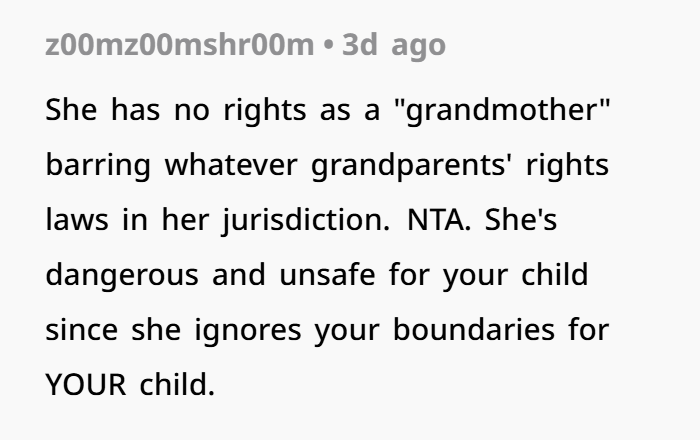
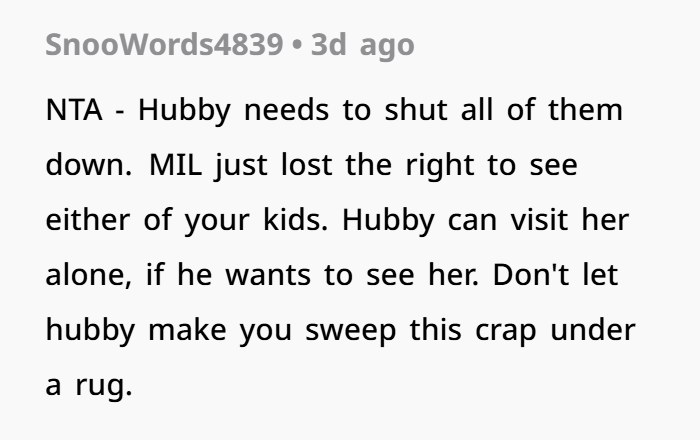
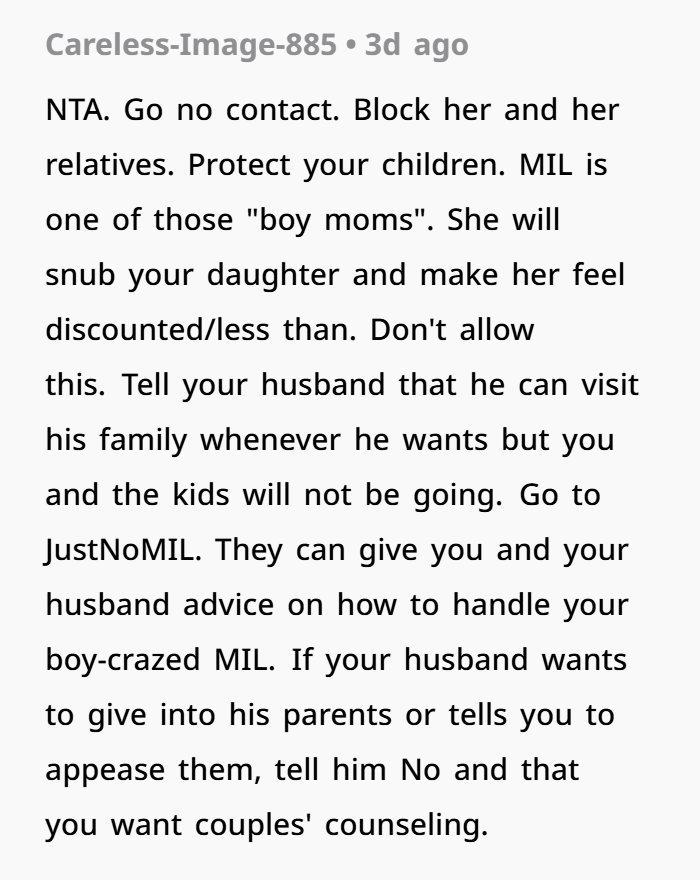
The woman addresses concerns about boundaries and the family drama that followed


Absolutely, this was not a small mistake—it was a deliberate test. Your MIL wasn’t just acting out of ignorance or impatience; she was testing whether she could:
- Override your choices as a parent,
- Undermine your authority in front of your child,
- Replace you in making decisions when you weren’t looking.
And you said no. You stood firm in protecting your child, and that is a powerful act. It wasn’t just about the feeding decision—it was about asserting your role and making sure that your boundaries as a mother are respected. You made it clear that no one has the right to make decisions for your child without your consent, especially when it comes to something as personal as feeding and caregiving.
Now, the focus needs to shift to whether your husband is willing to stand fully with you. Words matter, but actions speak louder. His role in this situation is crucial because, without action, your boundaries remain vulnerable.
1. Boundaries Without Enforcement Are Just Suggestions
You’ve established your boundaries—and they are important. But boundaries, without enforcement, are nothing more than suggestions. If your husband doesn’t stand with you in this moment, it sends a message that your parental authority isn’t fully supported.
Boundaries are only effective when they are respected and enforced by everyone involved, especially your partner. If your husband doesn’t take action to ensure your authority is upheld, it leaves you in a difficult position of having to defend your decisions alone, making you feel unsupported in your own home. This is a situation where both parents need to be aligned in their approach to raising and protecting their children.
2. The Importance of Unity as Parents
Your kids deserve to have both parents protect them together, and that means you need to be in agreement on how to handle boundaries and family dynamics. You’re not just protecting your authority; you’re protecting your kids from a situation where their boundaries and emotional safety could be compromised by someone who refuses to respect them.
When both parents work together to set and uphold boundaries, it creates a unified front that provides emotional security for the children. They see that their parents are on the same page, and that support will give them confidence as they grow.
3. What Needs to Happen Now
- Have a Clear Conversation with Your Husband: You need to ensure that he fully understands the importance of this issue—not just the actions of your MIL, but the underlying need for you both to be firm, united, and consistent in enforcing boundaries.
- Enforce Boundaries Together: Talk with him about how this situation cannot continue without clear consequences. You need him to take a stand alongside you and support you in maintaining these boundaries.
- Decide What the Next Steps Are: If your MIL continues to undermine your authority, what will be the consequences? Will there be limited contact, or will you need to take more drastic steps to protect your family? You and your husband need to decide together what will happen moving forward to ensure this behavior doesn’t happen again.
4. Conclusion: Protecting Your Family’s Well-Being
What your MIL did was a clear test of your authority as a parent. You said no, and that was a powerful stand in protecting your family. Now, it’s time to see whether your husband is fully aligned with you in protecting your children and your role as a parent.
Boundaries must be enforced, and both of you need to be united in that. Your kids deserve parents who work together to protect their emotional and physical well-being. This is about more than just setting limits with your MIL—it’s about creating a safe, supportive environment for your children, where both parents are strong and consistent in their decisions.
In the end, this situation isn’t just about defending yourself—it’s about ensuring that your family is protected and united in love and respect.