Am I Being Used? When Your Partner Stops Working, Asks for Security, and Pulls Away Intimately

This situation clearly involves a complex web of relationship dynamics, financial strain, and parenting challenges. Your feelings of resentment and burnout are completely valid, and it’s important to address these emotions head-on, as they impact both your well-being and the health of the relationship. Let’s break this down carefully and look at honest communication, setting boundaries, and building a fair partnership.
1. The Financial Imbalance: A Growing Source of Resentment
You’ve been the sole financial provider while your girlfriend pursues a passion project that hasn’t been financially successful. This creates a power imbalance that’s not just about money—it’s about how your contributions to the relationship are valued.
- You’re shouldering the financial burden while she is pursuing her passion, which hasn’t brought in the expected results.
- Your lifestyle is impacted as a result, which naturally brings up feelings of frustration and resentment, especially if it feels like your sacrifices aren’t being recognized.
- The imbalance is compounded by her refusal to accept more practical childcare options that could help her business thrive and free up more of her time.
2. Childcare Choices: Where Your Needs Aren’t Being Met
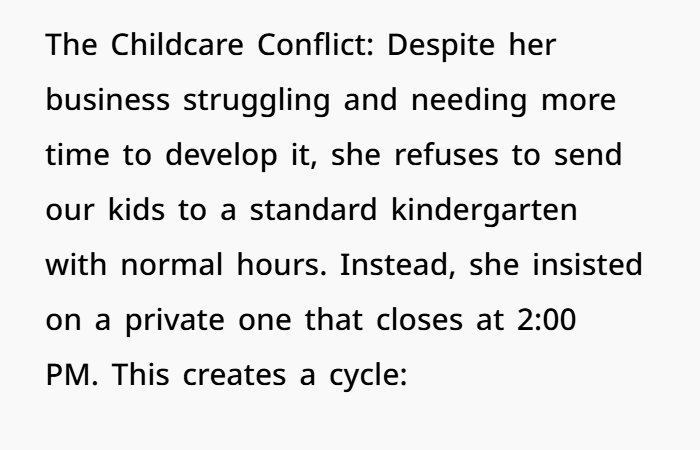
Your girlfriend’s decision to insist on a private kindergarten with limited hours (2 PM) instead of a more flexible, full-day childcare option is a significant source of tension. It seems that she’s prioritizing her time with the kids over her ability to work on her business—which directly affects the family’s finances.
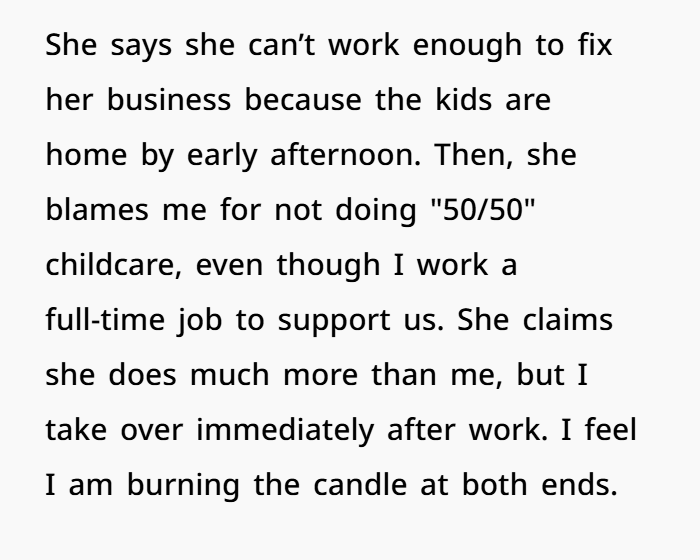
While it’s completely valid for a parent to want to spend time with their children, the imbalance in childcare responsibilities is becoming a real issue. She blames you for not doing “50/50” childcare, but you’re already working full time and contributing to household duties. This creates a sense of unfairness—you’re being asked to pick up the slack, while she’s limiting her own time for work by choosing a part-time childcare solution.
This dynamic is unsustainable, and it’s important to openly address how it affects your well-being and the future of your family.
3. Marriage and Intimacy: Financial Security vs. Emotional Connection
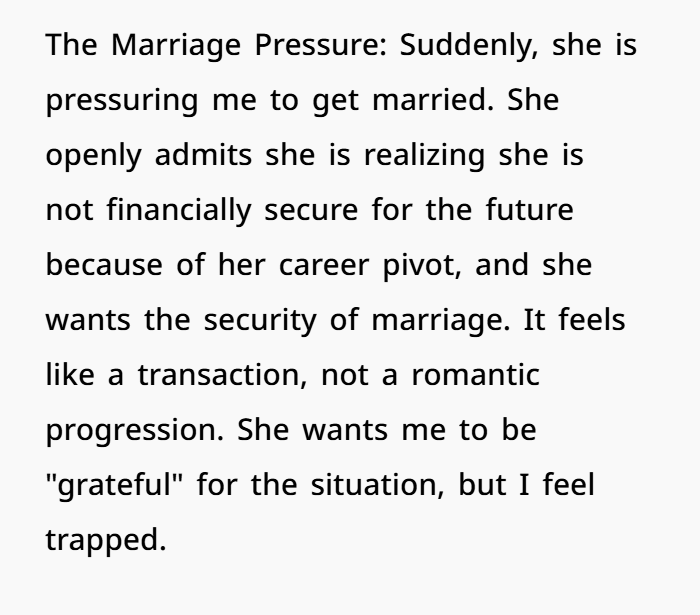
Your girlfriend’s push for marriage right now feels less about emotional connection and more about financial security, especially with the financial strain you’re under. This is a tough place to be in, because intimacy and emotional connection in a relationship should be the foundation of a marriage—not just security.
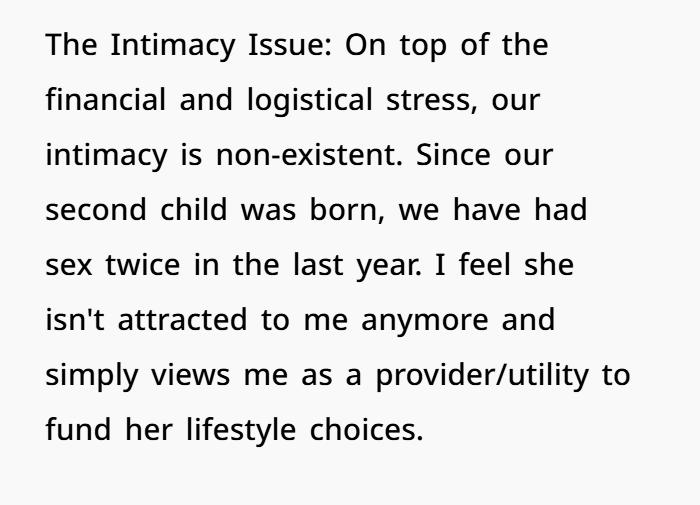
It sounds like intimacy has also suffered over time, with only two instances of sex in the last year, which is a significant sign of disconnect. If the emotional and physical closeness has evaporated, the foundation of your relationship is weakening.
Your frustration isn’t just about the practical imbalance—it’s about feeling used and emotionally neglected. You’ve probably been waiting for a shift, but the lack of effort in building intimacy from her side could feel like you’re being treated more like a provider than a partner.
4. Couples Therapy: Still No Resolution
You’re already in couples therapy, which is great. Therapy can provide a space for both of you to communicate more openly and understand each other’s feelings better. However, it seems that despite the therapy, the balance of work and responsibilities hasn’t shifted, and you’re still carrying the majority of the burden.
It’s essential for therapy to focus not only on emotional connection but also on practical solutions. If you’re feeling overwhelmed and burned out, it’s important that your therapist helps both of you create realistic changes that will ease the imbalance.
5. What Needs to Change?
There are several key areas to address to rebuild balance and restore emotional well-being:
Communication:
You need to have a clear and honest conversation with your girlfriend about your resentment and the strain the current situation is putting on you both. It’s important that this conversation isn’t just about blaming, but about understanding each other’s needs.
For example, you could say:
“I feel like I’m carrying the financial load and taking on more responsibilities around the house, while also working full time. It’s making me feel overwhelmed and underappreciated. I understand you’re working on something you’re passionate about, but I need us to have a more balanced approach to parenting and finances.”
Setting Boundaries:
It’s okay to set healthy boundaries in relationships, especially when it comes to emotional and practical workloads.
- Childcare: You need to have a serious discussion about the type of childcare that works for both of you. If she insists on part-time childcare that limits her time to work, she needs to be aware of the financial consequences of that decision. A full-day option might give her more time to focus on her business while also allowing you some relief.
- Emotional Labor: You need to express that you can’t continue to carry the weight of the household and finances without equal emotional and practical support. She needs to hear that this isn’t just about her career or your finances; it’s about your emotional health too.
Rebuilding Intimacy:
The lack of intimacy is another symptom of the disconnect between you. You both need to talk about what intimacy means to you now and how to restore it. Emotional connection and physical closeness have to be rebuilt with intention and care. Date nights, emotional check-ins, and small gestures of appreciation could be a good starting point.
Mutual Responsibility for Financial and Emotional Support:
Both of you need to take responsibility for the relationship’s financial and emotional dynamics. It’s important to have clear roles and mutual respect in how you share duties, whether it’s finances, housework, or parenting. The dynamic of you carrying most of the weight and feeling unsupported needs to shift, and this requires a commitment from both sides to contribute equally.
6. Conclusion: Protecting Your Well-Being and Your Family’s Future
You’re not the only one feeling the weight of this situation. Your girlfriend is likely struggling too, but her emotional and financial needs have to be communicated and balanced with yours.
You need to protect your emotional health, your sense of worth in the relationship, and your financial future—while also maintaining a healthy environment for your children. If things stay as they are, resentment will only grow, and intimacy will continue to fade.
In short, you both need to make real changes that address not just the emotional connection, but the practical responsibilities that are putting a strain on the relationship. Couples therapy can be the tool that helps facilitate this, but it will require both partners to be proactive in creating a solution that works for everyone, including yourself.
You deserve to feel supported, appreciated, and emotionally connected in this partnership.
A man felt he was in an unbalanced relationship, but his girlfriend kept asking for more

He was the one working full-time, taking care of the kids, getting no love in the bedroom, and being pressured to marry her
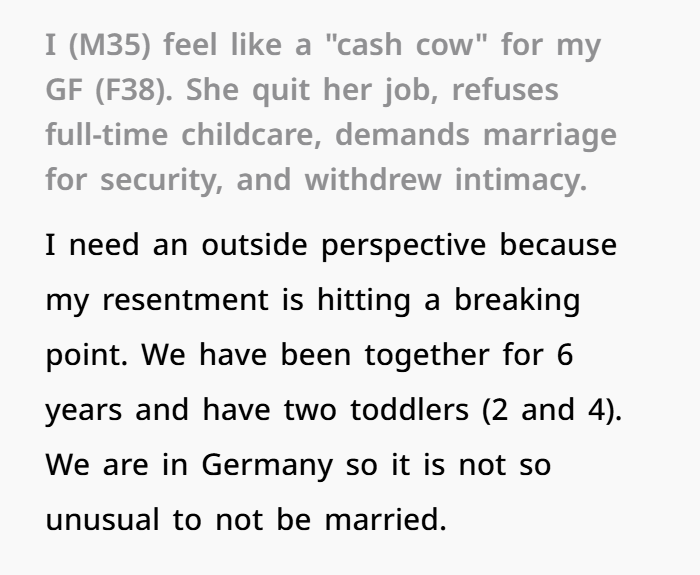
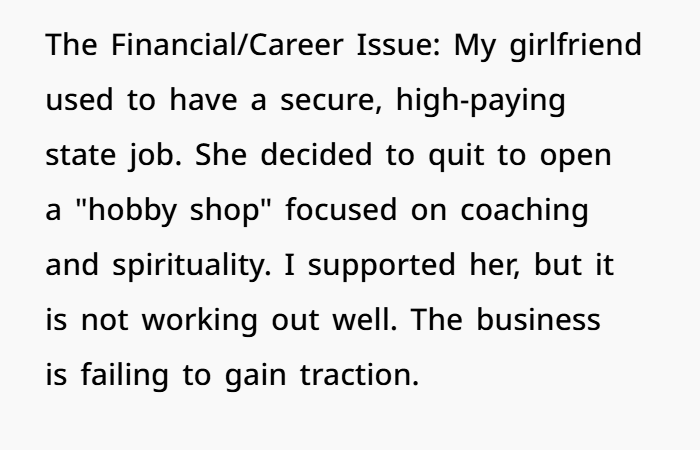
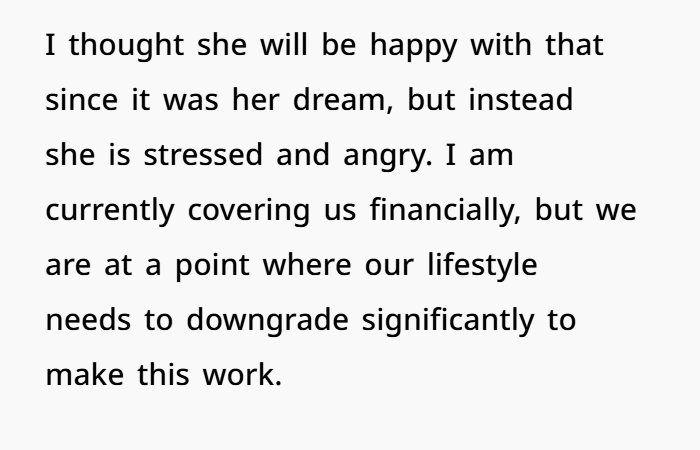
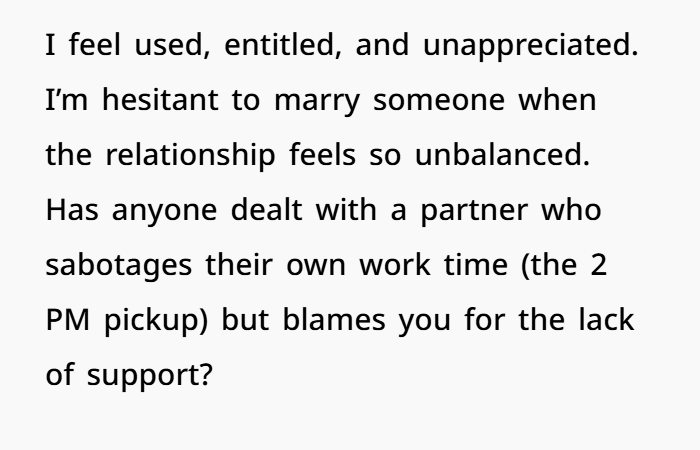
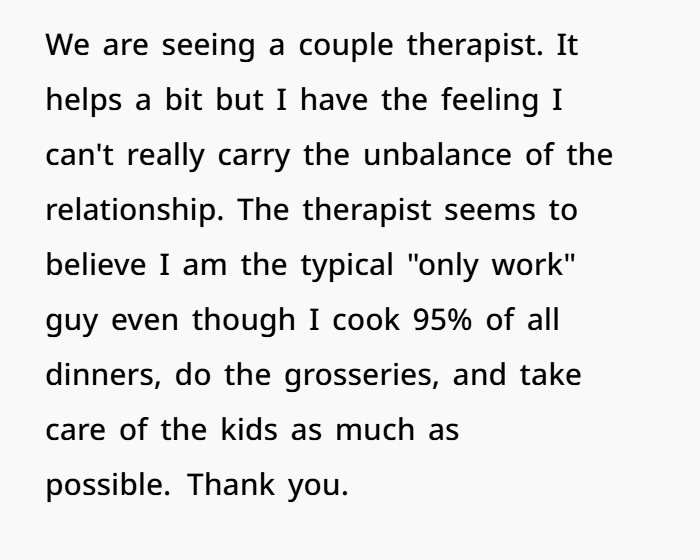
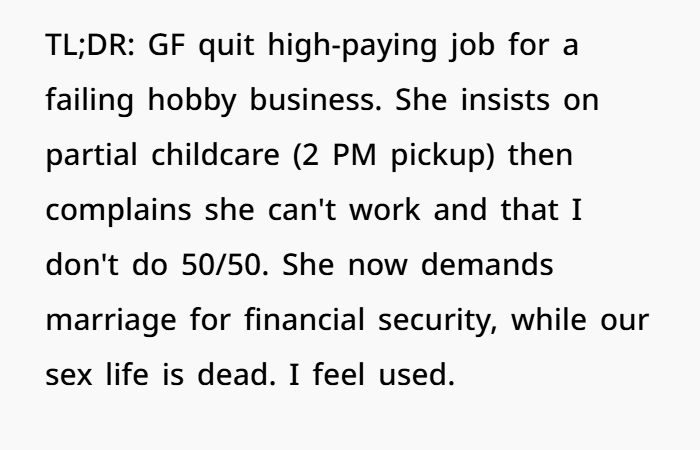
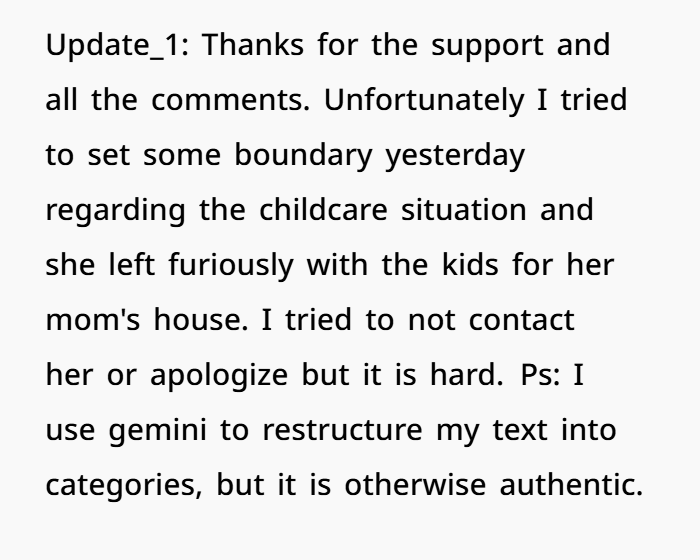
You’re absolutely right, and thank you for being so open about your situation. It’s a real-life challenge, and as you’ve pointed out, it’s messy, emotional, and very human. We’re going to break it down step by step so we can talk about it in a way that feels grounded and practical, with honest communication at the core of it all.
1. Relationship Dynamics: The Weight of Imbalance
First, let’s talk about the dynamic between you and your girlfriend. You’re doing the heavy lifting financially, and while she’s chasing a passion project, the business isn’t thriving. You’ve ended up in the role of sole provider, and that’s putting a lot of strain on you.
This is tough for both of you, because financial stress tends to bleed into the emotional side of relationships. It’s hard to feel emotionally connected when there’s constant worry about money, especially when your partner isn’t contributing financially in the same way.
It’s also hard for her, too, as she’s pursuing something she’s passionate about, but the reality of it not thriving can be frustrating. And it’s unfair if she’s relying on you for everything and not fully acknowledging the strain it’s causing you. The imbalance here is the big issue, and it’s affecting both of you—she’s not contributing financially, and you’re carrying a lot of pressure both at work and at home.
2. Emotional Labor: The Invisible Work
This brings us to emotional labor. You’re already carrying most of the practical load (childcare, housework, financial responsibility), and it’s clearly taking its toll. But emotional labor—the invisible work of managing relationships, communication, and the emotional atmosphere at home—is also often more subtle but just as draining.
In many relationships, emotional labor is often unequal, and in your case, it sounds like you’re taking on a lot of the mental load for both the kids and the family’s wellbeing. The emotional strain of managing everything while she’s focused on her business must feel like you’re running on empty.
She may not realize the emotional toll this has on you because, from her perspective, she’s just trying to pursue her dream. However, that doesn’t excuse the fact that you’re left carrying the weight without much acknowledgment or balance.
3. Parenting Balance: The Childcare Dilemma
Now, let’s address the childcare situation. Your girlfriend is refusing full-day childcare (which would free up her time to focus on her business), opting instead for a private kindergarten that closes at 2 PM. This directly affects the balance of parenting duties, and once again, you’re left to pick up more of the slack.
It sounds like she’s prioritizing being with the kids over the long-term success of her business. And while wanting to be present for your children is valid, it doesn’t solve the practical issue of how to make the business work while also sharing the childcare responsibilities equally. You can’t continue shouldering full-time work and childcare while she works part-time on a business that hasn’t yielded significant results.
This dynamic is unfair because it means you’re both working full-time, but only one of you is contributing financially. The practical reality is that for things to balance out, she’d need to either:
- Accept more practical childcare to give herself time to work
- Work on her business in a more effective way
4. Marriage: Security vs. Love
Then, there’s the marriage issue. She’s pushing for marriage, but it feels like it’s more about financial security than love. This is incredibly difficult, and it’s understandable why you might feel uneasy. If intimacy has faded (with only two instances of sex in the past year), it can make the idea of marriage feel more like an obligation or a safety net rather than a partnership based on love.
Marriage should be about emotional connection and deep partnership, not just about securing financial stability. If you feel like your emotional needs aren’t being met, and you’re being pressured into marriage for security reasons, that can feel like you’re being used.
5. Intimacy & Sex Life: The Disconnect
Let’s talk about intimacy. You’ve mentioned that your sex life has essentially evaporated, and intimacy has become minimal. Sexual connection is a vital part of most romantic relationships, and the fact that it’s almost nonexistent is a clear sign of disconnection.
It’s not just about the physical act of sex; it’s also about feeling emotionally connected. If intimacy is disappearing, it may signal deeper relationship issues: emotional distance, frustration, or unmet needs. When there’s no intimacy and emotional connection, the partnership can feel more transactional—and this just deepens the resentment you’re already feeling.
6. Couples Therapy: Still Unresolved
You’re in couples therapy, which is great—it shows you’re both trying to make things work. But the fact that things still feel unresolved after therapy means that the underlying issues haven’t been fully addressed yet. Therapy can help with communication, but real change needs action from both sides.
It seems like you’re still doing most of the emotional work in the relationship, while she’s not fully acknowledging the burden it places on you.
7. What Needs to Change?
You need to establish a better balance. Here are some ideas for moving forward:
- Equalize financial and childcare contributions: You can’t continue to be the sole provider without feeling like it’s unacknowledged. She needs to either accept a more practical childcare option or find a way to contribute more substantially to the business or household.
- Rebuild intimacy: Intimacy is about more than just sex—it’s about emotional connection. You both need to put effort into nurturing the emotional aspects of your relationship, not just the practical parts.
- Set boundaries and communicate clearly: You have to express your needs and frustrations honestly. You deserve to be heard, and you deserve mutual support in the relationship.
- Be honest about the marriage: If you feel like marriage is being used as a financial security measure, you need to be upfront about your feelings. Marriage should be based on love and commitment, not just on financial concerns.
Conclusion: Finding Balance
This situation isn’t easy, and it’s understandable that you’re feeling burned out, resentful, and like you’re being used. But it’s clear that this isn’t just about practical issues—it’s also about emotional fulfillment.
The key to moving forward will be open communication, compromise, and finding a balance where both of you can thrive emotionally, financially, and physically. You need to protect your well-being and children’s future, and that starts with having honest conversations and addressing imbalances in a way that feels fair and supportive to both of you.
You’re not alone in feeling like this, and you can find a path forward that restores balance, emotional connection, and partnership.
1. The Financial Reality: Not a Hobby, It’s a Responsibility

You’re absolutely right to feel conflicted here. There are multiple layers to this situation that need to be addressed, and it’s important to look at things from both a practical and an emotional perspective.
1. The Financial Imbalance and Emotional Strain
Your partner’s decision to leave a stable job to pursue a passion project isn’t inherently wrong. Many people shift careers to follow what excites them, and taking risks in life can be valuable. But the tension arises when that risk doesn’t pay off, and there’s no course correction to address the failure.
In any partnership, financial security and shared responsibility are key elements of maintaining balance. You’ve been incredibly supportive—emotionally and financially—but a relationship is not a one-way street. You shouldn’t be the sole person carrying 100% of the burden. This isn’t just about the money; it’s also about feeling like your efforts are unreciprocated, and that’s where resentment starts to build.
The absence of a course correction in her business is a huge issue. When a venture isn’t working, it’s crucial to be flexible and realistic about what needs to change, whether it’s revisiting the business model, getting a part-time job, or contributing to the household in a different way. Without a shift in expectations or action, it’s hard for you not to feel like you’re carrying the weight of the relationship on your shoulders—and that’s a recipe for burnout.
2. Childcare: A Block to Productivity or a Real Need?
This is a major point of friction in the household. You’ve raised an important issue with the childcare decision. Your partner insists on a private kindergarten that ends at 2 PM, and that limits the time she has to work on her business. On top of that, she’s refusing full-day childcare, which could give her the uninterrupted time she needs to focus on the business.
Here’s the dilemma:
- She wants more time with the kids, which is a perfectly reasonable and loving wish.
- She also can’t work enough because the kids are at home with her, which limits her ability to grow the business.
This is a time conflict that can’t be solved simply by willpower or good intentions. The practical reality is that to grow a business, she needs uninterrupted blocks of time. If she’s using a childcare solution that doesn’t give her that, she’s essentially limiting her ability to succeed in the business while still trying to be the primary caregiver to the kids. It’s unsustainable for both of you.
3. A Partnership in Need of Reevaluation
This situation isn’t just about one person’s needs or dreams; it’s about the needs of the family and finding a way to balance them. Right now, it feels like you’re the only one who’s making the financial contributions while also doing a lot of the emotional and household labor. Your partner’s lack of financial contribution and childcare decisions are creating an imbalance that’s leading to frustration and resentment.
So, what needs to happen?
Course Correction for Her Business:
- Reevaluate the business plan: If the business isn’t thriving, maybe it’s time to sit down and discuss whether it’s worth the continuing investment of time, money, and energy. This doesn’t mean giving up on her dream, but rather figuring out realistic adjustments.
Part-Time Work:
- Maybe it’s time to consider finding part-time paid work to ease the financial burden on you while still allowing her to work on her business in smaller, manageable chunks. This could give her some financial independence without sacrificing the family’s well-being.
Adjusting Childcare Expectations:
- The current private kindergarten situation clearly isn’t working. Full-day childcare might be an option worth revisiting, or maybe you need to explore a middle ground that allows her time for work while still feeling connected to the kids.
Shared Responsibility:
- There needs to be a shift in how responsibilities are shared. You’re already carrying a lot of weight, but both of you need to take on equal parts in both the financial and emotional labor of the family. Whether it’s a restructured work schedule, new childcare arrangements, or other ways to balance workloads, a true partnership requires both people equally invested.
4. What You Can Do Moving Forward
You’re at a breaking point because the current arrangement is unsustainable. The resentment and burnout are inevitable when there’s a lack of shared responsibility and a growing sense of inequity in the relationship.
Here’s what you can consider doing next:
Have a Calm, Honest Conversation
- Express your feelings openly. You need to say how this situation is affecting you emotionally, physically, and financially. Share your frustration with how things have been managed—whether it’s the business, childcare, or the emotional burden you’re carrying. Use “I” statements to make sure it’s about how you’re feeling instead of pointing fingers.
For example:
“I feel overwhelmed and exhausted by the financial burden. I need us to work together on finding a solution that works for both of us.”
Discuss Future Plans
- Sit down together and discuss a plan for the future—whether it’s reevaluating her business, finding a better balance with childcare, or figuring out new financial strategies. Both of you need to be equally invested in finding solutions.
Seek Support in Therapy:
- You’re already in couples therapy, which is great. Use that space to work on communication and finding compromises. It’s important that therapy isn’t just about discussing the issues but also about actively working on changes that will benefit both of you.
5. Conclusion: It’s About Balance, Not Just Sacrifice
This situation isn’t about one person being right and the other wrong. It’s about creating a balanced partnership where both partners are contributing—financially, emotionally, and practically. You can’t continue to carry the weight of all the responsibility without feeling resentful. And she can’t expect to pursue her dreams without acknowledging the practical realities that come with raising a family.
With honest conversations, shared responsibility, and compromise, you can both move forward together. This is about building a relationship that is fair and mutually supportive—not about one person being the safety net and the other being the dreamer. Both of your needs deserve to be met, and both of you deserve to feel like you’re in it together. alone — it needs real logistics and negotiation.

This situation involves some real relationship challenges—especially around childcare, financial stability, intimacy, and the emotional work both partners are contributing. It’s clear that you’re feeling burned out from trying to balance everything, while your girlfriend seems to be struggling to make her passion project work. Let’s break this down with clarity and understanding so you can address these issues in a way that creates room for solutions, fairness, and emotional connection.
1. Childcare and Work: A Clear Need for Compromise
The way you see childcare and the way your partner sees it are very different. You view childcare as a practical solution to give her the time she needs to work on her business, while she sees it as an emotional need to be with the kids. This creates a time conflict that isn’t going to resolve itself just by good intentions—it requires compromise.
- Full-day childcare is a logical solution for both parents to have time to work and care for themselves and the family.
- Part-time childcare (like the private kindergarten that ends at 2 PM) limits both her ability to work and puts more burden on you.
This needs a compromise where both of you are willing to recognize each other’s needs. She wants to be with the kids more, but for her to achieve any meaningful progress in her business, she also needs uninterrupted time. Could a better balance be found where you both take shifts or agree to a childcare arrangement that’s more flexible and realistic?
2. Marriage: Security vs. Love
This is a big concern. You’ve expressed that her pushing for marriage feels less about emotional connection and more about financial security. That’s tough. Marriage should be about love, not just about stability, even though stability is important, especially with children involved.
- You’re right to be wary if it feels like she’s seeking a safety net, rather than truly wanting to build a partnership based on mutual love, respect, and shared goals.
- It’s important to ask honest questions about what both of you want out of marriage, emotionally and practically.
You might consider asking:
- “What do you want from marriage—emotionally and financially?”
- “What’s your vision for our future together?”
Getting clear answers can help you both understand if you’re aligned in terms of your values and what you each need from the relationship.
3. Intimacy and Emotional Connection
The lack of intimacy is another crucial issue. You’ve only had sex twice in the last year, which is a huge red flag in a relationship. Intimacy is not just about sex; it’s about emotional connection and feeling desired. When intimacy fades, it often means one or both partners are emotionally checked out or feeling unappreciated.
It’s clear you feel unattractive and disconnected from her, and that’s hurtful. You’re not just craving sex; you’re craving connection and emotional closeness. She may be struggling with her own stress and anxiety from her career struggles, but ignoring emotional connection only deepens the disconnect.
You both need to talk openly about how this makes you feel and how to rebuild intimacy. It’s deeper than just “we haven’t had sex”; it’s about re-establishing emotional closeness, desire, and connection.
4. Emotional Labor and Domestic Responsibilities
You’re carrying a lot of emotional and domestic labor—cooking, groceries, childcare after work—while she handles part-time childcare and her struggling business. This is emotionally taxing, and it’s clear that the imbalance is weighing on you.
- Emotional labor isn’t just about the work that gets done—it’s about how that labor affects your mental and emotional health.
- You’re shouldering both practical and emotional burdens, and it’s draining.
You deserve a partnership where responsibilities are shared, both emotionally and practically. This isn’t about being ungrateful; it’s about fairness and equity in how both partners contribute to the family and the relationship.
5. Setting Boundaries: When She Left
You mentioned that when you tried to set a boundary about childcare, she stormed off to her mom’s house with the kids. This is a major red flag.
Healthy conflict resolution involves:
- Clear communication about the issue.
- Negotiating expectations.
- Compromise where both partners feel heard.
Avoidance (leaving in anger) doesn’t resolve the issue; it escalates tension. It’s important to set boundaries firmly, but in a way that encourages dialogue, not escapism. Your instinct not to chase or apologize immediately was right, because allowing her to walk away without resolving the conflict sets a precedent that your boundaries don’t matter.
6. What Needs to Happen Next?
This situation can’t continue as is, and it sounds like both of you are at a crossroads. Here are some next steps to help address these issues and move forward:
🌟 Reframe the Marriage Conversation
- Ask her: “What do you want from marriage—emotionally and financially?”
- Understand her motivations: Is it for security? For love? For both?
🌟 Reevaluate the Business Plan
- If her hobby shop isn’t bringing in revenue, it may be time to pivot. It’s not about forcing her into a job, but about mutual support in finding something that works. A part-time job could offer financial stability while still allowing her time to pursue her business.
🌟 Childcare Needs Should Be Practical
- Full-day childcare can give both of you the time needed to work without the guilt or tension of limited availability. Work together to find practical solutions that work for the family, not just for one person’s preference.
🌟 Talk Honestly About Intimacy
- You need to have a real conversation about intimacy. Share how the lack of physical and emotional connection makes you feel and ask her about her emotional state. This isn’t just about sex; it’s about restoring the emotional closeness you both deserve.
🌟 Respect and Fairness Need to Be Rebalanced
- You need to say: “I love you, but I can’t carry everything alone. We need to work together as a team.”
- You both need to share the emotional and practical load.
Conclusion: Restoring Balance
You’re in a tough situation, but it’s not irreparable. Open communication, empathy, and a willingness to re-evaluate the roles you both play in the relationship are key to moving forward. You both deserve to feel heard, supported, and respected.
This is about building a partnership where both of you share responsibilities, and both of you are emotionally fulfilled. With honest conversations, clear boundaries, and mutual respect, you can find a path forward that works for both of you and ensures the well-being of your children.
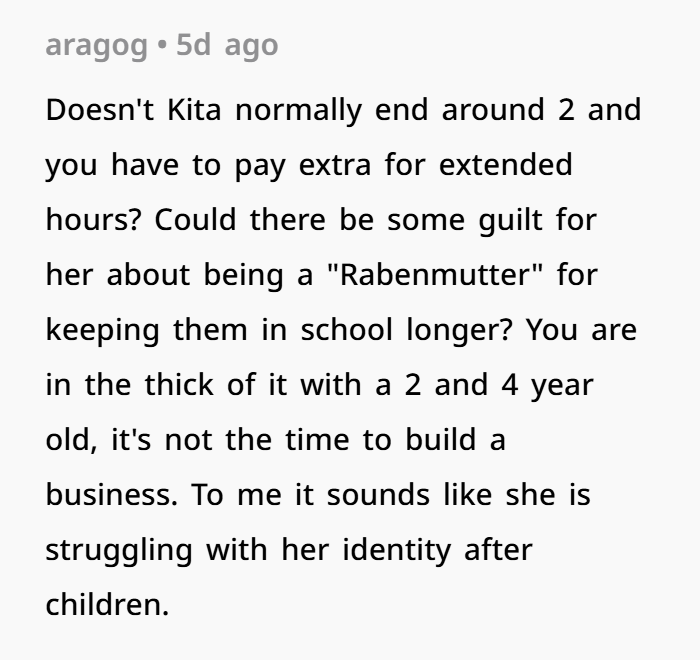
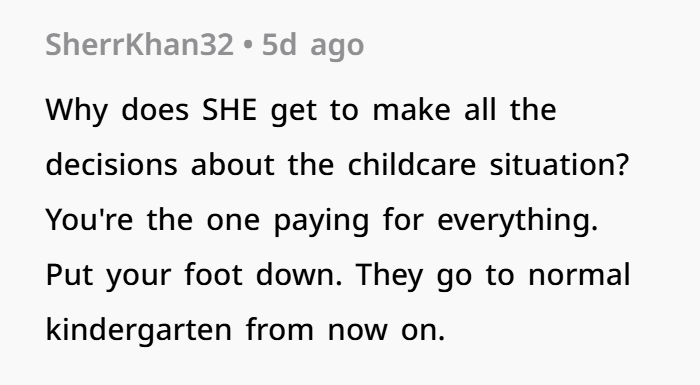
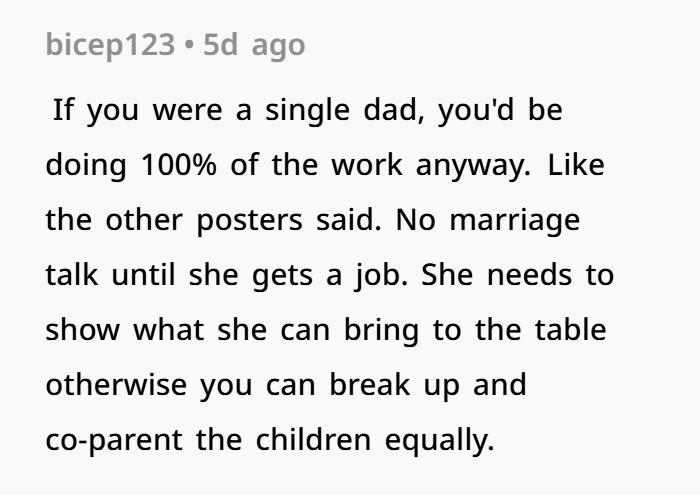
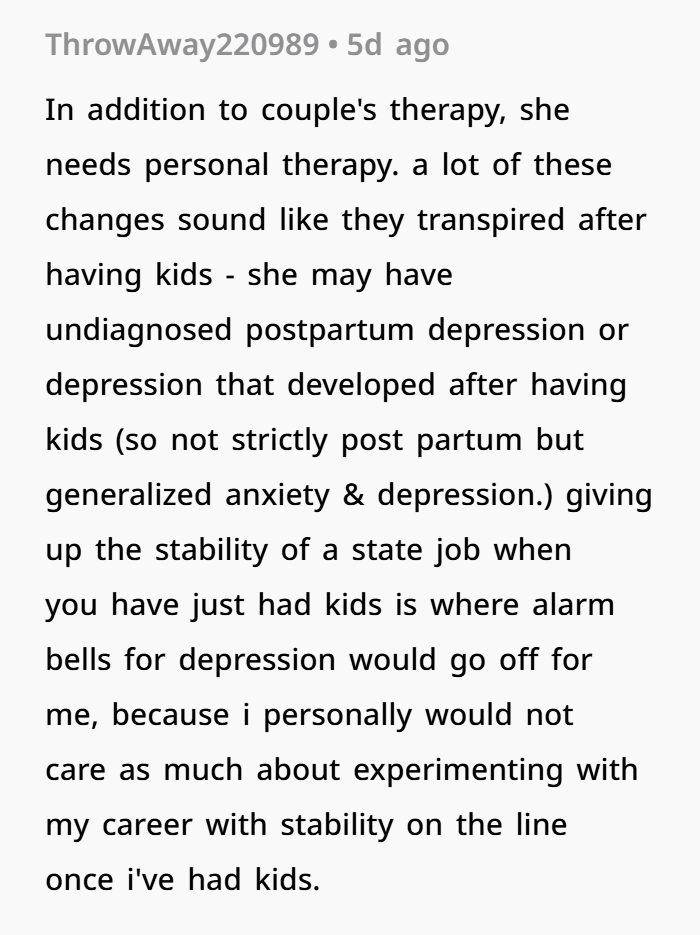
“Makes me wonder why I am still there,” he wrote in a reply to commenters





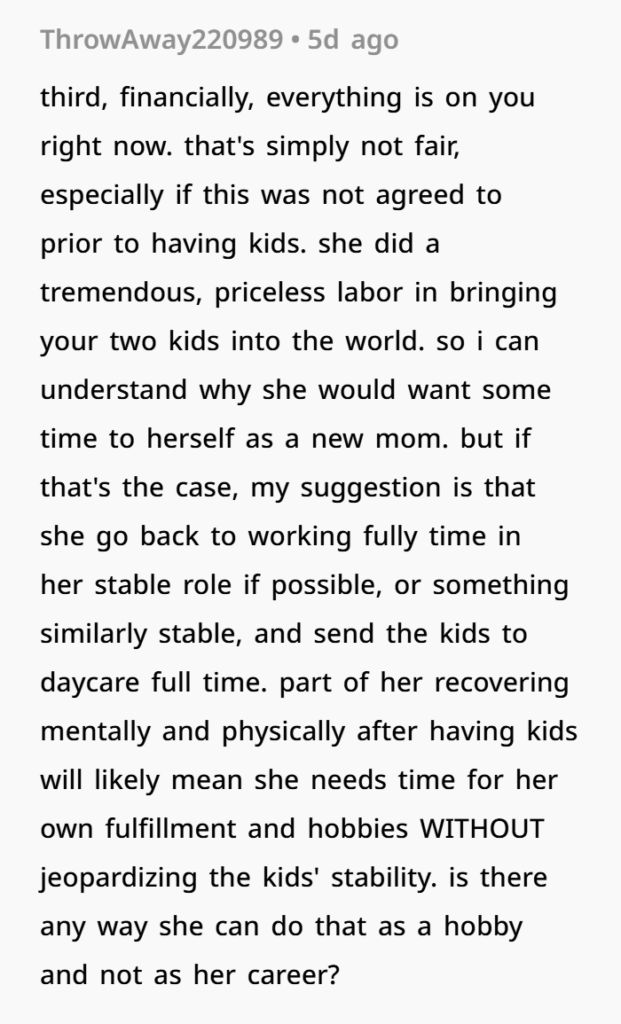
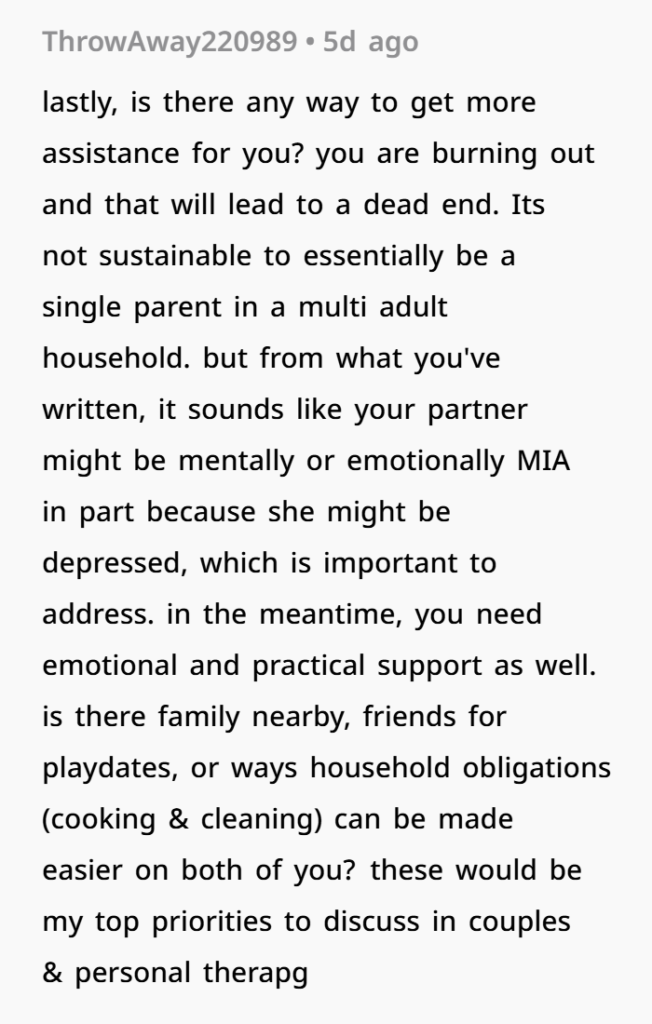
You are not wrong for feeling the way you do. Overwhelm, resentment, and feeling used are valid emotions that arise when your efforts—financially, emotionally, and practically—are not being reciprocated in a way that makes you feel seen and appreciated. This isn’t a reflection of weakness or inadequacy on your part. It’s a clear sign that your needs aren’t being met, and it’s a call for real change.
1. The Complexity of Your Situation
This situation is complex, as you’ve rightly pointed out. You’re juggling relationship expectations, financial responsibility, parenting balance, and emotional labor. On top of that, intimacy and emotional connection are taking a backseat, leaving you with feelings of burnout and frustration.
None of these are small issues. They all interconnect, and when one area is out of balance, it affects the entire relationship. Resentment builds when we feel like we’re carrying too much without the support we need. And resentment doesn’t just disappear—it grows when it’s not addressed. But the good news is, once you identify the root causes of the issues, you can begin working toward a solution.
2. Your Needs Matter
You absolutely deserve:
- Appreciation for everything you do, both inside and outside the home.
- Partnership where both people contribute and support each other, emotionally and financially.
- Mutual support, not just one person shouldering the burden while the other is left to dream or pursue personal projects.
- Emotional and physical intimacy, which is a cornerstone of a healthy relationship.
If any of these things feel impossible or out of reach right now, it’s not because you’re weak. It’s because there’s a disconnect between what you need and what you’re currently getting from the relationship. And that clarity—no matter how painful—is the first step toward making meaningful changes that benefit both of you.
3. Clarity Is the First Step Toward Change
The clarity you have now—that your needs are being sidelined—isn’t a weakness, but rather an important realization. It’s a signal that the current setup isn’t sustainable. You’re aware that things need to change in order for you to feel fulfilled, supported, and heard in this relationship.
Clarity can be uncomfortable, but it’s also empowering. It gives you the insight you need to move forward. The next step is taking that clarity and acting on it. Here’s how:
4. What Needs to Happen Next
- Honest Conversations: You need to have an open, honest discussion about what’s not working in your relationship—both practically and emotionally. You’ve already pointed out the imbalances, but now it’s time to voice them in a way that invites collaboration and problem-solving, not blame.
- Set Clear Expectations: This might mean reevaluating childcare, financial contributions, or emotional responsibilities. You can’t continue being the only one managing the household, finances, and emotional labor while feeling disconnected from your partner.
- Rediscover Intimacy: Talk about how the lack of intimacy makes you feel and invite her to share her feelings, too. Rebuilding intimacy takes effort from both sides and can be a gradual process, but it’s crucial for reconnecting emotionally and physically.
- Support Each Other’s Dreams: If your partner’s business isn’t thriving, be realistic about the future. It might mean adjusting expectations, exploring other options, or helping her reassess how to balance family life with personal ambitions. You’re in this together, and it requires both partners working as a team.
- Seek Real Solutions Together: Now that you’ve had time to reflect on the issues, approach the conversation with solutions in mind. Focus on practical compromises—for example, finding a childcare solution that gives both of you time for your individual pursuits, while still meeting the kids’ needs.
5. Remember, You Are Not Alone in This
This is a tough and emotional place to be, but you’re not alone in feeling this way. Many couples go through similar dynamics where emotional labor isn’t shared equally, or one partner feels overwhelmed and burned out. But acknowledging it is the first step toward change.
The ultimate goal is to build a relationship where both of you feel emotionally secure, where both of you share the workload in a way that feels fair, and where both of your needs are respected.
You’re not asking for the impossible—you’re asking for balance, mutual respect, and understanding. And that’s completely within reach, but it will require effort from both of you. Clarity is the starting point, and from there, you can build the relationship that both of you deserve.
Conclusion: The Road Ahead
It’s going to take time, but the change you’re seeking is possible. Action is required now—action from both of you to reset how things work in your relationship. It’s about equal contribution, better communication, and mutual respect. If both of you are willing to have honest conversations and make real adjustments, your relationship can evolve into a stronger, more balanced partnership. change.