Wife Asks Husband to Split Car Expenses He Regularly Uses—He Calls It “Generous,” She Calls It Fair

This situation dives deep into the complexities of financial fairness, shared responsibilities, and the dynamics of ownership in a marriage. Let’s break it down:
1) The Issue of Ownership and Use
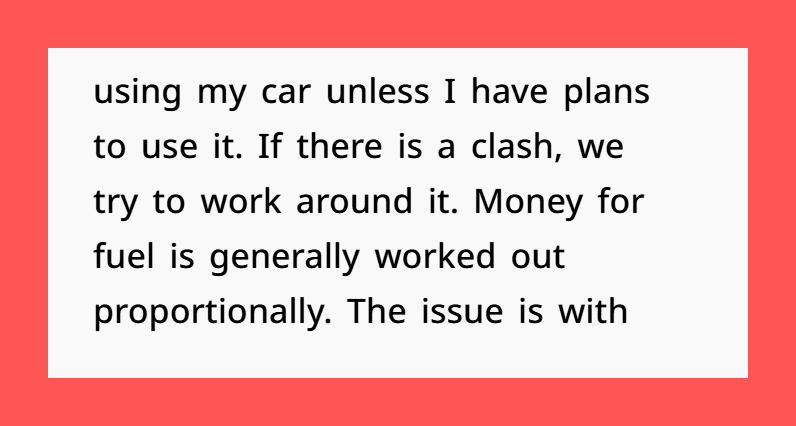
The key point here is that the wife’s car is personally owned, and while they share a joint account for household expenses, the car itself has remained separate. However, after moving to a rural area, the husband’s reliance on the wife’s car for daily commutes and errands changes the context. The car that was once personal property is now essentially shared, given that both parties are using it regularly.
2) The Husband’s Resistance to Shared Costs
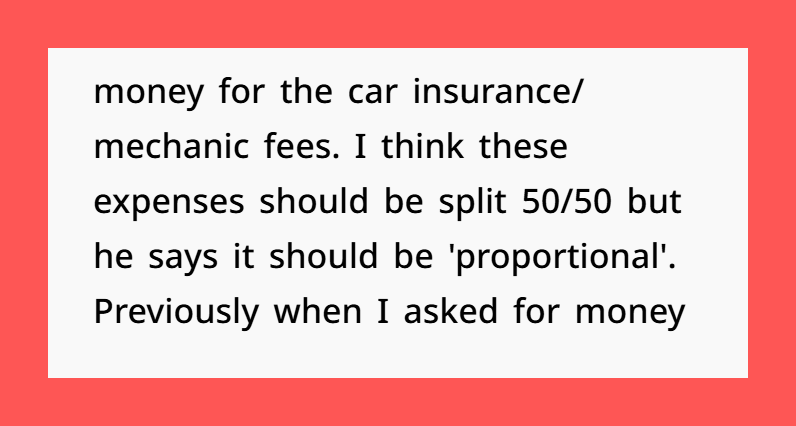
The husband’s argument is that contributions to car-related expenses—like insurance and mechanic bills—should be “proportional” to usage. This logic seems to suggest that the wife should shoulder more of the costs because she owns the car. While this seems fair from a certain perspective, it also assumes that ownership and use should be treated as entirely separate in terms of financial responsibility. But given that both partners are relying on the vehicle, and both are benefiting from it, the notion of proportional contributions feels somewhat imbalanced.
3) Shared Reliance vs. Ownership
The wife’s perspective is rooted in shared reliance—if they are both using the car daily, the costs should be shared equally. Her belief is that the joint nature of their usage should translate into a joint financial responsibility, regardless of the vehicle’s ownership. The idea of shared expenses is common in many partnerships, especially when both parties benefit equally from an asset.
4) Generosity vs. Obligation
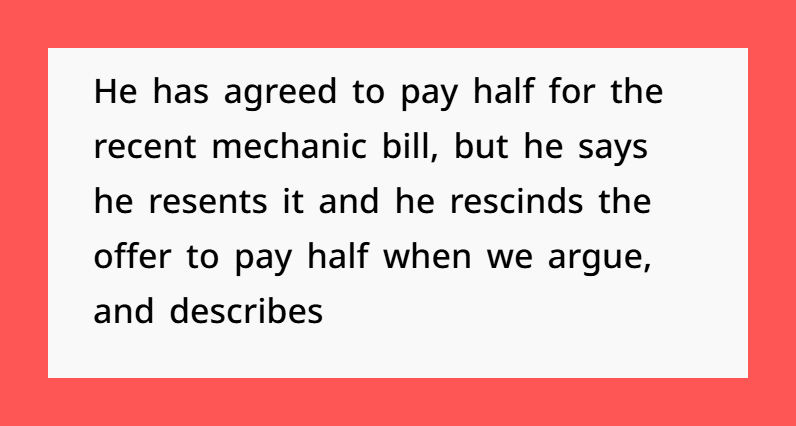
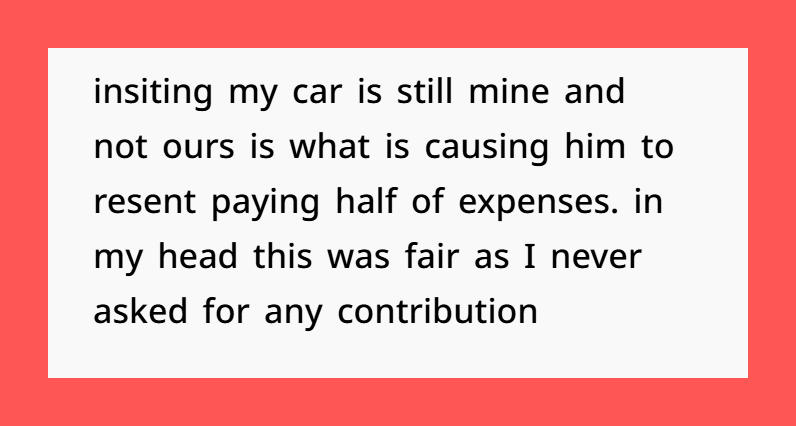
The tension here also highlights a deeper divide between how each person sees contributions. The husband views any contribution to car expenses as an act of generosity, meaning he feels like he’s doing something extra by helping with costs. On the other hand, the wife sees it as an obligation because, in her view, they’re both benefiting from the same resource, so the financial responsibility should be shared.
5) Past Disparities and Financial Values
This argument is not just about who should pay what for the car—it’s also about past financial dynamics in their relationship and possibly deeper, unspoken financial values. If one partner has been shouldering a larger share of costs or has historically felt financially disadvantaged, it can create resentment when a more equal responsibility is needed. The car situation brings these deeper financial disparities into focus, which could be a symptom of broader issues in how they handle money as a couple.
6) Deeper Financial Implications
The disagreement also shines a light on how they handle money overall. Is it based on fairness and equality, or does it lean more toward individual responsibility for assets that belong to one person? It also raises questions about how they view shared resources—in this case, a shared car—and what that means in terms of financial contributions.
Conclusion: Finding a Fair Solution
This issue requires clear communication and a commitment to shared responsibility. Both partners should come to the table with the understanding that fairness in shared resources—whether it’s a car or any other joint expense—should be rooted in mutual agreement. The wife has a reasonable point about the car being used jointly, and the husband should recognize that in terms of financial responsibility.
They could consider:
- Splitting car expenses 50/50, acknowledging the mutual benefit and shared use of the vehicle.
- Alternatively, they could adjust the proportionality argument by factoring in the financial capacity of both partners—this would recognize that while the car is owned by the wife, the husband still contributes to the household as a whole.
Ultimately, both partners need to revisit their financial values and ensure that they align with their long-term goals as a couple—whether that’s based on fairness, shared responsibility, or a balance of both. Open, honest discussions about finances can help prevent resentments from building up and allow both partners to feel that the arrangement is equitable.
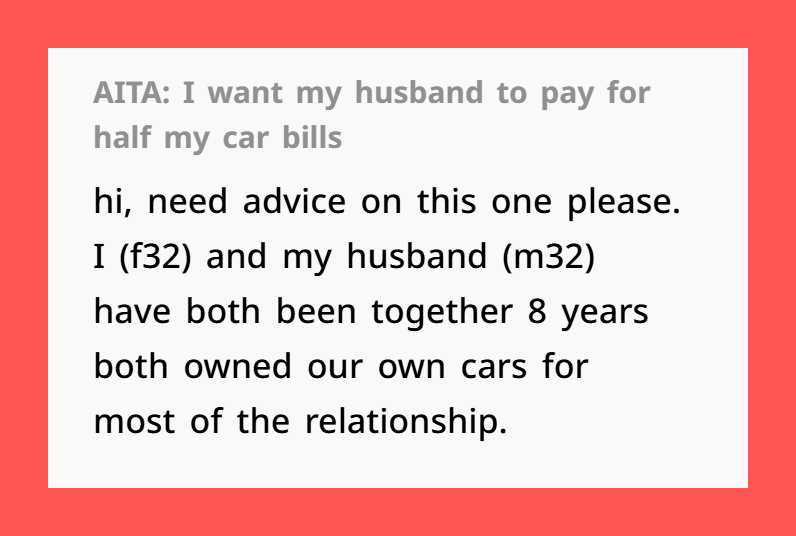
Husband and wife disagreed on paying their car’s mechanical bills 50/50

The husband argued that since it’s technically his wife’s car, paying half would be unfair to him

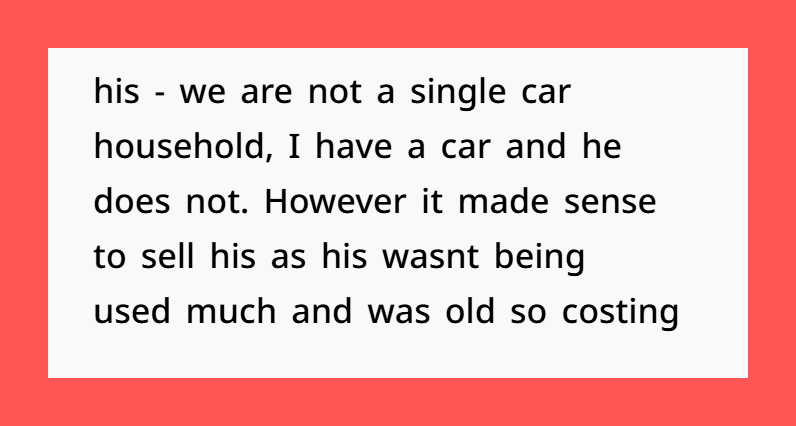













Navigating financial responsibilities within a marriage, especially concerning shared assets like a vehicle, can be complex and requires open communication and mutual understanding. Your situation, where your husband sold his car and now both of you rely on yours, brings up valid questions about how to equitably share associated expenses.
Understanding Shared Financial Responsibilities

In relationships, especially marriages, financial arrangements often evolve over time. Many couples decide to combine their finances, contributing to joint accounts for shared expenses such as housing, utilities, and groceries. However, when it comes to assets that were individually owned before becoming shared resources, determining fair contributions can get tricky. The situation with the car is a perfect example of how couples navigate the balance between ownership and joint use.
Approaches to Sharing Vehicle Expenses
Given that the car has become the primary vehicle for both partners, here are a few approaches to divide the associated costs fairly:
- Equal Split:
In this method, all vehicle-related expenses—including insurance, maintenance, and fuel—are shared equally. This approach reflects the joint usage of the vehicle and the shared dependency on it. Since both partners are using the car regularly, splitting costs 50/50 is one of the simplest and most transparent ways to ensure fairness. - Proportional Split:
This method divides costs based on usage or income. For example, if one partner uses the car more frequently, they might contribute a larger percentage toward the expenses, such as fuel and maintenance. Alternatively, if there is a significant income disparity, the partner earning more might contribute a larger share of the fixed expenses, like insurance. This method takes into account not just usage but also financial capacity, ensuring that contributions are adjusted according to what each partner can afford. - Hybrid Approach:
A combination of the two previous methods. In this approach, fixed costs, like insurance, are split equally, since they are not directly impacted by usage. Meanwhile, variable costs, such as fuel and maintenance, are divided based on usage. For instance, if one partner drives the car more, they would cover a larger share of fuel costs, while both share equally in the more predictable, fixed expenses.
Conclusion: Choosing the Right Approach
The best method depends on your specific situation as a couple. If both partners use the car equally, an equal split might feel most fair. If one partner depends on the car more than the other or has a higher income, a proportional split might be better. And if you’re looking for a compromise, a hybrid approach could provide the balance of fairness while recognizing both shared usage and financial differences.
What’s most important is open communication and agreement on what feels fair to both partners. Whether you go for an equal, proportional, or hybrid approach, the goal is to maintain balance and fairness in the relationship—especially when it comes to shared resources like a car.
Considerations and Recommendations

- Communication: Engage in an open dialogue with your husband about both of your expectations and feelings regarding the car expenses. Understanding each other’s perspectives can lead to a more amicable agreement.
- Documentation: Once an agreement is reached, consider documenting it to avoid future misunderstandings. This doesn’t have to be a formal contract but a written understanding can be beneficial.
- Future Planning: Discuss long-term solutions, such as the possibility of purchasing a second vehicle if the current arrangement becomes untenable.
- Financial Counseling: If disagreements persist, seeking advice from a financial counselor can provide neutral guidance tailored to your specific situation.
The wife clarified that the couple doesn’t disagree on other money issues and all other expenses are joint




Your desire for a fair and equitable sharing of car-related expenses is completely understandable, especially considering how much both of you rely on the vehicle. While your husband may view his contributions as generous, it’s important to establish a system that fairly acknowledges both partners’ needs and circumstances.
The key here is to have an open, collaborative discussion where both of you can express your concerns, expectations, and what feels fair. You’re not asking for more than what’s reasonable; you’re asking for a system that reflects the shared responsibility in your marriage. Mutual agreements around finances, especially in a partnership, are crucial to ensure that both parties feel valued and heard in decisions that impact both of you.